
Digital Marketing Specialization Finder
Not sure where to start? Answer these quick questions to find your ideal entry point into digital marketing.
Loading question...
Your Recommended Path:
SEO
Why this fits you
Reasoning goes here.
First Project Idea
Project details...
Key Tool to Learn
Tool Name
Next Steps
You’re staring at job listings that all seem to require three years of experience in SEO, paid ads, and content strategy. It feels like a catch-22: you need the job to get the experience, but you need the experience to get the job. But here’s the truth most hiring managers won’t tell you upfront: digital marketing is one of the few high-growth fields where entry-level barriers are surprisingly low for self-taught individuals who can prove their skills through projects rather than degrees. You don’t need a background in business or tech. You just need curiosity, a laptop, and a willingness to break things until they work.
Most people quit before they even start because they try to learn everything at once. They sign up for a massive bundle covering every platform from TikTok to LinkedIn Ads, then drown in tutorials. The secret isn’t knowing everything; it’s picking one lane and going deep enough to generate results. Whether you’re in Toronto or anywhere else, the market rewards output, not just attendance. Let’s strip away the jargon and look at how you actually go from zero to hireable without burning out.
The Myth of the "Perfect" Background
Forget the idea that you need a marketing degree. In 2026, employers care less about your diploma and more about your portfolio. Did you grow an Instagram account to 1,000 followers? Did you write a blog post that ranked on Google? Did you run a $50 ad campaign that brought in sales? These are tangible proofs of skill. A digital marketing course can teach you theory, but it cannot replace the messy reality of managing a real budget or dealing with an algorithm update.
Think of it like learning to cook. Reading recipes helps, but you only learn by tasting and adjusting. If you have no experience, your first "job" is your own project. Start a niche website, a newsletter, or a social media page dedicated to a hobby you already love. This removes the pressure of client expectations while letting you experiment freely. When you eventually apply for jobs, you won’t say, "I took a class." You’ll say, "I grew traffic by 40% in three months using these specific tactics." That narrative is infinitely more powerful.
Picking Your First Specialization
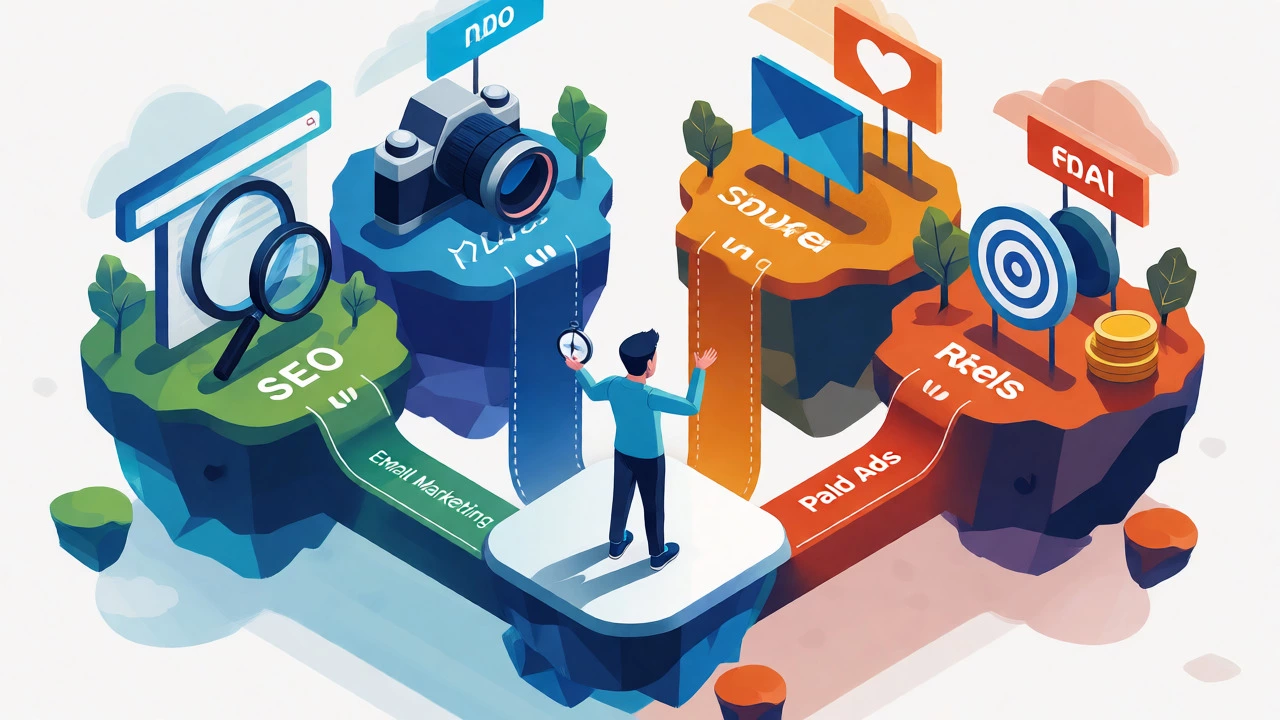
Digital marketing is too broad to master all at once. Trying to be an expert in SEO, PPC, email, and social simultaneously is a recipe for mediocrity. Instead, choose one area based on your natural strengths. Are you analytical? Look into data-driven roles like Pay-Per-Click (PPC) management. Are you creative and empathetic? Content marketing or social media might fit better. Do you enjoy psychology and persuasion? Email marketing could be your gateway.
| Specialization | Best For... | First Project Idea | Key Tool to Learn |
|---|---|---|---|
| SEO | Logical thinkers who enjoy long-term problem solving | Audit a local business website | Google Search Console |
| Social Media | Creatives who understand trends and visual storytelling | Grow a niche TikTok or Instagram page | Meta Business Suite |
| Email Marketing | Writers who like direct communication and metrics | Create a lead magnet and landing page | Mailchimp or Klaviyo |
| Paid Ads | Detail-oriented people comfortable with budgets | Run a small Facebook Ad campaign | Facebook Ads Manager |
Notice that each path requires different tools. Don’t buy subscriptions yet. Most platforms offer free tiers or trials. Use them. The goal is to understand the interface and the logic behind the clicks. Once you pick a lane, stick with it for at least three months. Switching every two weeks means you never reach competence.
Building a Portfolio Without Clients
You might think you need paying clients to build a portfolio. Wrong. You need case studies. A case study is simply a story about a problem you solved. Since you don’t have clients yet, create problems for yourself. For example, if you chose SEO, take a friend’s small business website. Analyze its speed, keyword gaps, and backlink profile. Write a report detailing what’s wrong and what you would do to fix it. Then, implement one change-like optimizing meta titles-and track the result over a month.
This approach demonstrates initiative and analytical thinking. Employers know beginners make mistakes. They want to see that you can identify issues, propose solutions, and measure outcomes. Document everything. Take screenshots of your analytics dashboards before and after your interventions. Save your written reports. Compile these into a simple PDF or a personal website. This document becomes your resume substitute when you lack traditional work history.
The Role of Certifications vs. Skills
Should you pay for a digital marketing course? Yes, but be selective. There are thousands of options, ranging from $10 Udemy classes to $5,000 bootcamps. At the entry level, expensive certifications often hold less weight than practical ability. However, certain industry-standard badges do help pass HR filters.
Focus on free or low-cost resources first. Google offers the Fundamentals of Digital Marketing certification for free, which covers the basics well. HubSpot Academy provides excellent training in inbound marketing and content strategy. Meta Blueprint teaches you how to navigate their advertising ecosystem. These aren’t magic tickets to a job, but they show you’ve taken the time to learn the official language of the platforms.
Here’s a quick heuristic for choosing a paid course: Does it include live mentorship or feedback? Pre-recorded videos alone are rarely worth the premium price unless they are exceptionally well-produced. Look for programs that force you to submit assignments for review. Feedback loops accelerate learning far faster than passive watching.
Navigating the Job Market as a Beginner
When you’re ready to apply, avoid generic "Marketing Assistant" roles if possible. They often involve menial tasks like scheduling meetings or ordering office supplies. Instead, look for titles like "Junior Social Media Coordinator," "Content Writer," or "SEO Intern." These positions are more likely to let you touch actual campaigns.
Networking matters more than applying online. In cities like Toronto, many junior roles are filled through referrals. Attend local meetups focused on startups or marketing. Don’t ask for a job immediately. Ask for advice. People love sharing their expertise. If you show genuine interest and demonstrate some prior knowledge (from your personal projects), you become memorable. Follow up with a thank-you note and a link to your portfolio. This human connection often bypasses the automated resume screening software.
Be prepared for rejection. You will hear "no" frequently. Treat each interview as a free consulting session. Note down the questions you couldn’t answer. Study those topics. Return to the next interview better prepared. Persistence beats perfection in this field.

Common Pitfalls to Avoid
One major mistake is chasing shiny objects. Every week, a new AI tool or social platform emerges. Beginners often panic, thinking they’re falling behind. Ignore the hype cycle for the first year. Master the fundamentals of audience targeting, copywriting, and data analysis. These skills transfer across platforms. A good marketer can adapt to any new channel because they understand the underlying principles of human behavior and measurement.
Another trap is ignoring analytics. Many beginners focus entirely on creativity and neglect the numbers. If you can’t explain why a campaign succeeded or failed using data, you’re just guessing. Learn basic Excel or Google Sheets functions. Understand metrics like Click-Through Rate (CTR), Conversion Rate, and Cost Per Acquisition (CPA). Being able to tie your creative work to revenue makes you indispensable.
Next Steps for Your Journey
Start today. Not tomorrow. Pick one specialization from the table above. Sign up for a free account on the relevant platform. Spend two hours reading the documentation or watching a tutorial. Then, launch a tiny experiment. It doesn’t matter if it fails. Failure provides data. Success provides confidence. Both are valuable.
Keep a learning journal. Write down what you tried, what happened, and what you learned. After six months, you’ll have a collection of insights that no textbook could provide. That collection is your competitive advantage. You’re not just someone who watched videos; you’re someone who has tested hypotheses in the real world.
Do I need a computer science degree for digital marketing?
No, absolutely not. While technical skills help, especially in areas like SEO or programmatic advertising, most digital marketing roles value creativity, communication, and analytical thinking over coding knowledge. Tools have become user-friendly, allowing non-technical users to manage complex campaigns effectively.
How long does it take to get a job in digital marketing with no experience?
Typically, 3 to 6 months of dedicated self-study and project building. If you treat learning like a part-time job (10-15 hours a week), you can build a portfolio strong enough to land an internship or junior role within that timeframe. Consistency is key; cramming for two weeks won't yield the same results as steady practice.
Are free courses enough to learn digital marketing?
Free courses from providers like Google, HubSpot, and Meta cover the theoretical basics very well. However, they often lack personalized feedback. To bridge the gap, combine free courses with active practice-running your own ads or writing content-and consider joining online communities where you can ask questions and get peer reviews.
What is the best digital marketing niche for beginners?
There is no single "best" niche, but Social Media Management and Content Writing are often the easiest entry points because they require minimal financial investment to start testing ideas. SEO is also accessible but takes longer to show results. Choose based on whether you prefer creative expression (social/content) or analytical problem-solving (SEO/analytics).
Can I work remotely in digital marketing?
Yes, digital marketing is one of the most remote-friendly industries. Many companies hire freelancers and full-time employees globally. However, competition for remote roles is higher, so having a strong portfolio and clear communication skills is crucial to stand out against local candidates.
Leave a comments