
Trading Career Path Finder
Not sure which degree to pursue? Answer these three questions to find your ideal academic path for a career in trading.
You see the traders on TV, making split-second decisions that move millions. You wonder if you need a fancy MBA or a PhD in mathematics to get in the game. The truth? It is less about the piece of paper on your wall and more about what that paper taught you to do with numbers, risk, and human behavior. But does it matter which degree you pick? Absolutely.
If you want to trade stocks, currencies, or commodities, you are entering a field where financial literacy is non-negotiable. While some successful traders are self-taught, having the right academic background gives you a massive head start. It helps you understand the "why" behind price movements, not just the "what." So, which degree actually gets you hired by a prop firm or helps you survive as an independent trader?
Finance: The Direct Path to Market Mechanics
A Bachelor of Science in Finance is arguably the most straightforward route into the trading world. Why? Because you spend four years studying exactly what you will do every day. You learn how to value assets, how interest rates affect bond prices, and how corporate balance sheets drive stock valuations. This isn't abstract theory; it is the toolkit you use to analyze a company before buying its shares.
Most top-tier investment banks and proprietary trading firms recruit heavily from finance programs. They know these students already speak the language. You won't have to waste six months learning what a P/E ratio is. Instead, you can focus on execution and strategy. However, a pure finance degree can sometimes lack the quantitative rigor needed for high-frequency trading or complex derivatives. If you plan to build algorithms, you might find yourself needing extra math courses.
Economics: Understanding the Big Picture
While finance looks at individual companies, economics teaches you to look at the entire machine. Macroeconomics explains why the Federal Reserve raising interest rates crashes tech stocks. Microeconomics helps you understand supply and demand shocks in commodity markets like oil or wheat. Traders who understand economic cycles often outperform those who only look at charts.
An economics degree trains your brain to think in models and probabilities. You learn to assess how political events, inflation data, and global trade policies ripple through markets. This macro-awareness is crucial for currency traders (Forex) and commodity traders. If you enjoy connecting dots between a drought in Brazil and coffee futures prices, economics is your playground. Just be aware: pure economics degrees can be very theoretical. Look for programs with applied econometrics tracks to keep things practical.
Mathematics and Statistics: The Quant Edge
Modern trading is increasingly dominated by algorithms. If you want to work for a hedge fund like Renaissance Technologies or Citadel, a degree in mathematics or statistics is often preferred over finance. These roles require heavy-duty modeling, probability theory, and linear algebra. You aren't just reading news; you are coding systems that execute trades based on statistical arbitrage opportunities.
Quantitative traders, or "quants," earn some of the highest salaries in the industry because their skills are rare and hard to replace. A math degree proves you have the analytical horsepower to handle complex risk models. However, this path is brutal. It requires intense focus and a genuine love for abstract concepts. If you hate calculus, you will struggle here. But if you love puzzles and patterns, this degree opens doors that finance majors simply cannot walk through.
Computer Science: Building Your Own Tools
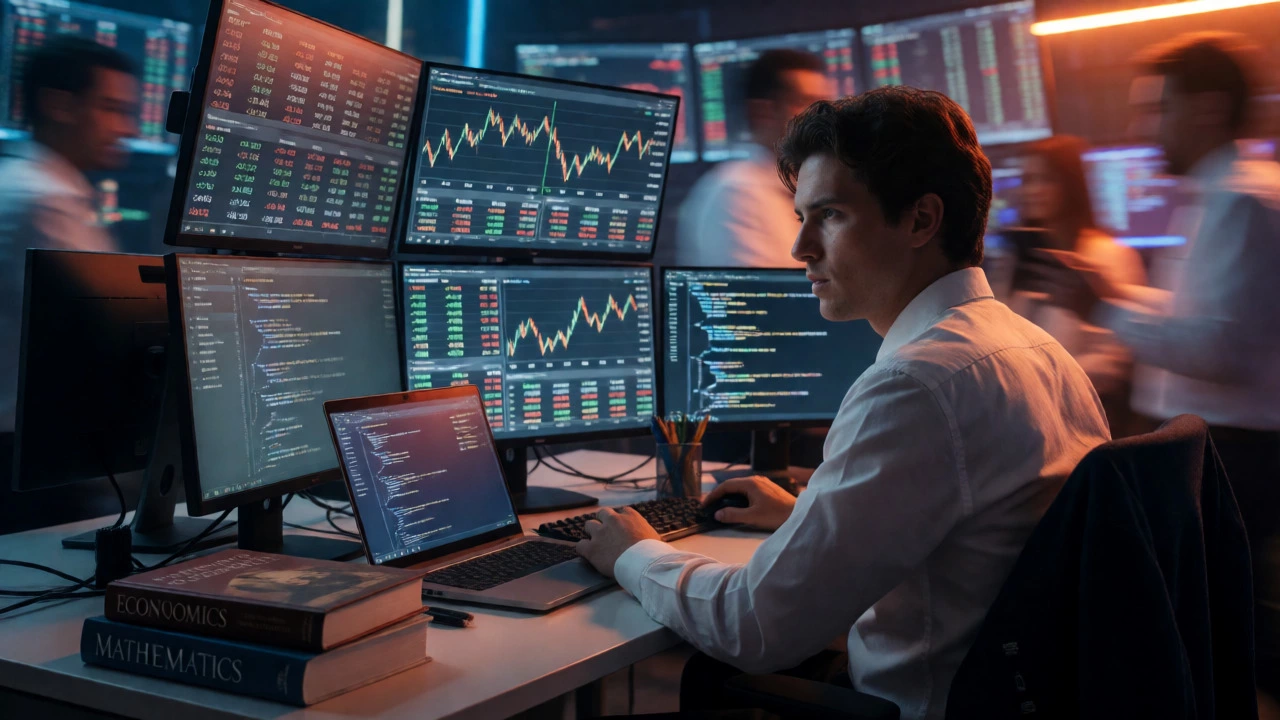
Trading without code is becoming harder. Whether you are backtesting strategies or automating order execution, programming skills are essential. A degree in computer science equips you with Python, C++, and data structures knowledge. Many modern trading platforms allow you to write custom scripts, and knowing how to optimize them saves time and money.
Algo-trading firms actively hire computer science graduates. They value the ability to build low-latency systems and process massive datasets quickly. Pairing a CS degree with self-study in finance creates a powerful hybrid profile. You become the person who can both design the strategy and build the bot that executes it. This versatility makes you indispensable in today's tech-driven markets.
The Comparison Table: Which Degree Fits Your Style?
| Degree Type | Best For | Key Skills Learned | Typical Career Path |
|---|---|---|---|
| Finance | Equity & Corporate Analysis | Valuation, Accounting, Portfolio Mgmt | Investment Banker, Equity Trader |
| Economics | Macro & Forex Trading | Econometrics, Policy Analysis, Modeling | FX Trader, Macro Strategist |
| Math/Stats | Quantitative Trading | Probability, Linear Algebra, Risk Models | Quant Analyst, Algo Trader |
| Computer Science | Algorithmic Execution | Python, C++, Data Structures, Latency | Quant Developer, HFT Engineer |
Does the University Brand Matter More Than the Major?
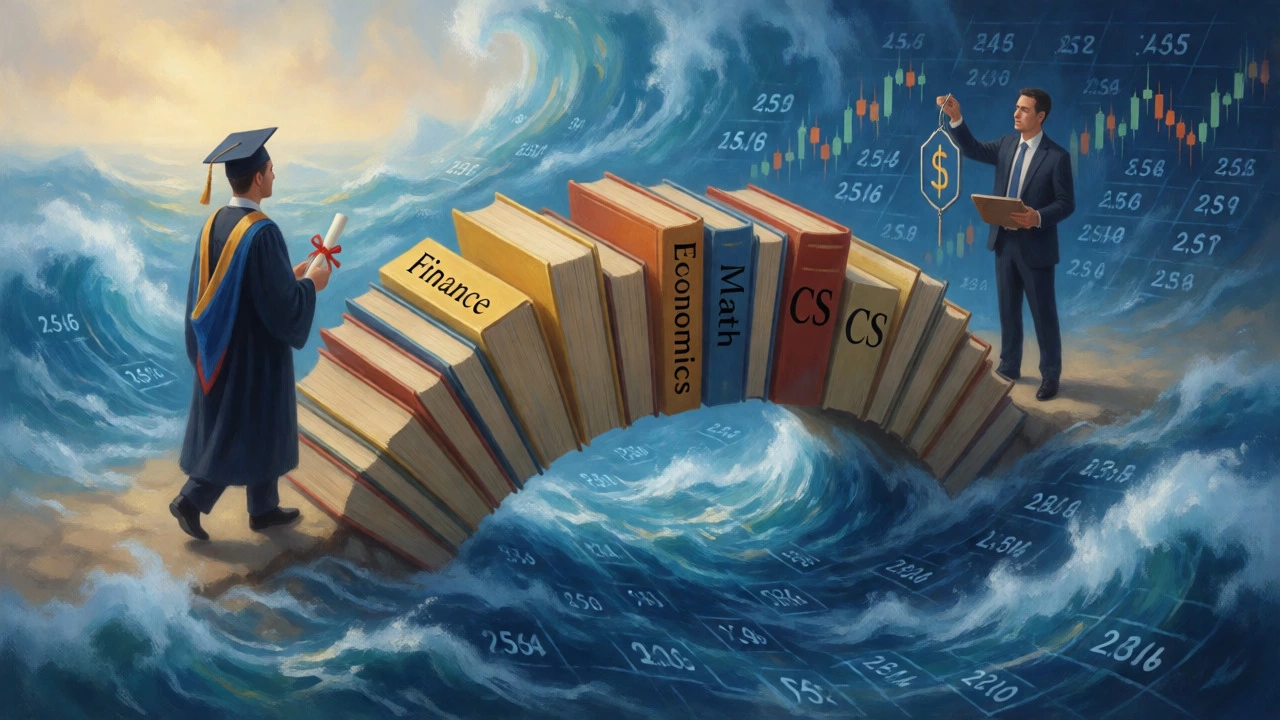
Here is a controversial take: for entry-level roles at elite firms, the prestige of your university often outweighs your specific major. Banks like Goldman Sachs or JPMorgan Chase recruit from target schools regardless of whether you studied History or Physics. Why? They assume smart people from top schools can learn the technical skills on the job. They are hiring for raw intelligence and trainability.
However, if you attend a mid-tier university, your major becomes critical. You need to differentiate yourself. A Finance or Math degree signals to recruiters that you have taken the initiative to learn relevant hard skills. In this case, the degree acts as proof of competence. If you are at a lesser-known school, consider pairing your degree with certifications like the CFA (Chartered Financial Analyst) Level 1 to boost credibility.
Beyond the Degree: What Actually Makes a Good Trader?
A degree gets you the interview. It does not make you profitable. Trading requires emotional stability, discipline, and risk management skills that no classroom fully teaches. You could have a PhD in Economics but still blow up your account if you panic-sell during a dip. Conversely, a disciplined trader with a general business degree can consistently beat the market.
Use your university years to build a trading journal. Paper trade (trade with fake money) while you study. Test the theories you learn in class against real market conditions. Did the interest rate hike really crash the bonds like the textbook said? Documenting this experience shows employers you have practical intuition, not just book smarts. Also, network aggressively. Attend finance clubs, meet alumni, and intern wherever possible. Relationships often open doors faster than transcripts.
FAQ: Common Questions About Trading Education
Can I become a trader without a college degree?
Yes, especially if you are an independent retail trader. Many successful day traders are self-taught. However, getting hired by institutional firms (banks, hedge funds) is extremely difficult without a bachelor's degree. Most HR filters automatically reject applications without one.
Is a Master's degree necessary for trading?
Not always, but it helps for competitive roles. An MBA or a Master's in Financial Engineering can pivot your career if your undergraduate degree was unrelated. For quantitative roles, a Master's in Math or Stats is often expected. For general equity trading, experience usually beats advanced degrees after three years.
Which is better for trading: Finance or Economics?
It depends on your trading style. Choose Finance if you want to analyze individual stocks and corporate fundamentals. Choose Economics if you prefer trading based on macro trends, interest rates, and global events. Both are respected, but Finance is more direct for fundamental analysis.
Do I need to learn programming for trading?
Increasingly, yes. Even discretionary traders benefit from basic Python skills to automate alerts and backtest strategies. For algorithmic or high-frequency trading, advanced programming in C++ or Python is mandatory. It allows you to remove emotional bias and execute trades faster.
What certifications help if my degree isn't related?
The Chartered Financial Analyst (CFA) charter is the gold standard. Passing Level 1 shows serious commitment. Other options include the FRM (Financial Risk Manager) for risk-focused roles or specialized online certificates from reputable universities. These signal to employers that you have bridged the knowledge gap.
Next Steps for Aspiring Traders
Pick a major that aligns with your natural strengths. If you love numbers and logic, go Math or CS. If you love stories and big-picture thinking, go Economics. If you love dissecting businesses, go Finance. Whatever you choose, supplement it with real-world practice. Open a demo account today. Start tracking the S&P 500 or Nifty 50. Read financial news daily. Your degree provides the foundation, but your curiosity builds the house.
Leave a comments