Coding Career Path Simulator (India)
Select your preferred tech stack and study intensity to estimate your job readiness timeline, potential salary range, and interview difficulty based on current Indian market trends.
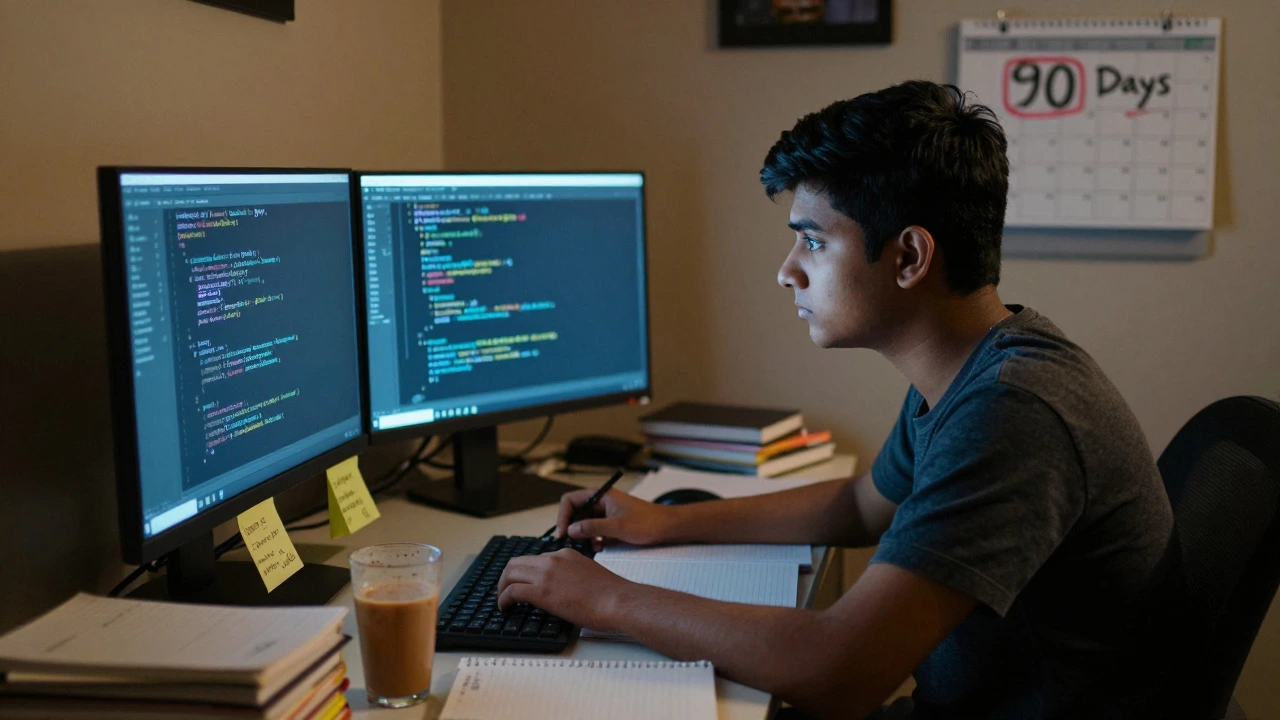
Three months. That’s roughly 90 days, or about 2,160 hours if you are awake. Is that enough time to go from knowing nothing about code to signing an employment contract as a software developer? The short answer is: yes, but with major caveats. It is not a guaranteed path, and it certainly isn’t easy. However, for motivated individuals in the Indian tech ecosystem, it is becoming increasingly possible-provided you choose the right stack, study like your life depends on it, and target the right entry-level roles.
The tech industry has shifted. While big product companies like Google or Amazon still demand years of experience or top-tier engineering degrees, the broader market-including service-based IT firms, startups, and digital agencies-is hungry for functional developers who can build things *now*. If you want to break into this field in just three months, you need a strategy that prioritizes employability over theoretical perfection.
The Reality Check: What "Learning to Code" Actually Means
Before you commit those next 90 days, let’s clear up a misconception. Learning to code in three months does not mean you will understand computer science deeply. You won’t be writing compilers or optimizing database kernels. Instead, you will be learning web development, specifically full-stack JavaScript or Python web frameworks. These are the most accessible entry points because they have high demand and relatively low barriers to entry.
In the context of computer courses in India, many institutes promise "job readiness" in 12 weeks. Some deliver; many do not. The difference usually comes down to curriculum focus. A course that spends two months teaching history and theory will leave you unemployable. A course that focuses on building real projects using modern tools might get you an interview. Your goal isn’t to know everything; it’s to know enough to solve specific business problems.
Choosing Your Tech Stack: Speed vs. Stability
To land a job in three months, you cannot afford to learn multiple languages. You need one stack that is in high demand and has a gentle learning curve. Here are the two best options for rapid entry:
- JavaScript Full-Stack (MERN): MongoDB, Express.js, React, Node.js. This is the most popular choice for bootcamps and self-learners. React is everywhere in frontend development, and Node.js allows you to use JavaScript on the backend too. The community support is massive, meaning when you get stuck (and you will), someone has already answered your question on Stack Overflow.
- Python Web Development: Django or Flask. Python is known for its readability. If you struggle with syntax complexity, Python is forgiving. Django, in particular, comes with "batteries included," giving you authentication, admin panels, and database management out of the box. This lets you build complete applications faster, which is crucial for a portfolio.
Avoid Java, C++, or Swift for this timeline. They require deeper understanding of memory management, object-oriented design patterns, and complex ecosystems. Stick to JavaScript or Python. They are interpreted languages, meaning you can see results immediately without compiling code, which keeps momentum high during intense study periods.
| Feature | MERN Stack (JavaScript) | Django (Python) |
|---|---|---|
| Learning Curve | Moderate (requires understanding async logic) | Easier (cleaner syntax) |
| Job Market in India | Very High (startups & agencies) | High (enterprise & data-driven apps) |
| Portfolio Speed | Fast (many UI libraries available) | Medium (more boilerplate needed) |
| Interview Difficulty | Higher (React concepts are tricky) | Moderate (focus on logic & DB) |
The 90-Day Battle Plan
If you treat these three months like a full-time job (8-10 hours a day), here is how you should structure your time. This plan assumes you are starting from zero.
Month 1: Foundations & Frontend Basics
Forget frameworks for the first two weeks. Master HTML5, CSS3, and vanilla JavaScript. Understand the Document Object Model (DOM). Build static websites. Then, move to a frontend framework. If you chose MERN, learn React. Focus on components, state management (useState, useEffect), and fetching data from APIs. By the end of Month 1, you should have built at least three interactive frontend projects, such as a weather app, a todo list with local storage, and a movie search tool.
Month 2: Backend & Database Integration
This is where most beginners quit. It gets abstract. Learn Node.js and Express (or Django). Understand RESTful API design. Connect your frontend to a database. Use MongoDB Atlas or PostgreSQL. Learn how to handle user authentication (JWT tokens or sessions). Build a CRUD (Create, Read, Update, Delete) application. For example, create a blog platform where users can sign up, post articles, and comment. Deploy this project to Vercel or Render so others can access it.
Month 3: Portfolio Polish & Job Hunt
Stop learning new technologies. Start applying. Refine your GitHub profile. Ensure every project has a README file explaining what it does, how to run it, and what tech stack was used. Create a personal portfolio website. Begin applying to internships, apprenticeships, and junior developer roles. Prepare for technical interviews by practicing basic algorithms on platforms like LeetCode (easy level only) and reviewing common system design questions for juniors.
Where to Find Opportunities in India
The Indian tech landscape is diverse. To get hired quickly, you need to look beyond the usual suspects. Here is where opportunities exist for freshers with limited experience:
- Service-Based IT Companies: Firms like TCS, Infosys, Wipro, and HCL often hire large batches of freshers. They provide training after hiring. The pay may start lower, but it offers stability and a foot in the door.
- Early-Stage Startups: Look on AngelList (Wellfound) or LinkedIn for startups in Bangalore, Hyderabad, Pune, and Delhi NCR. Startups care more about your ability to build than your degree. If you show them a working app, they might hire you.
- Digital Agencies: Marketing and web design agencies constantly need frontend developers to build client websites. These roles often require strong CSS and JavaScript skills rather than deep backend knowledge.
- Freelancing Platforms: Upwork and Fiverr can provide initial income while you hunt for full-time roles. Small gigs like fixing bugs or building landing pages help build confidence and resume credibility.
Note that remote work is increasingly common. You don’t necessarily need to relocate to Bangalore. Many global companies hire remotely from India, offering competitive salaries compared to local averages.

Pitfalls to Avoid
Many candidates fail not because they lack intelligence, but because they make strategic errors. Here are the biggest traps:
- Tutorial Hell: Watching video tutorials without typing code. You must build projects independently. If you can’t build it without a tutorial, you don’t know it.
- Ignoring Soft Skills: Communication matters. In interviews, explain your thought process. Employers hire people they can work with, not just coders.
- Applying Blindly: Sending 100 generic resumes yields fewer results than sending 10 tailored applications with personalized cover letters referencing specific company projects.
- Overlooking Networking: Join Discord communities, attend meetups (virtual or physical), and connect with recruiters on LinkedIn. Referrals bypass HR filters.
Is It Worth It?
Getting a coding job in three months is a sprint, not a marathon. You will likely start with a salary between ₹3 LPA and ₹6 LPA (Lakhs Per Annum) depending on location and company type. This is modest compared to experienced engineers, but it is a significant jump from non-tech entry-level wages. More importantly, once you are in the industry, your growth accelerates. After two years of experience, salaries can double or triple.
The key is persistence. Rejection is normal. You might apply to 50 jobs before getting one interview. Keep improving your portfolio. Keep learning. The tech industry rewards continuous learners.
Do I need a degree to get a coding job in 3 months?
No, you do not strictly need a degree. Many startups and smaller agencies prioritize skills and portfolios over formal education. However, large service-based companies often have HR filters that require a bachelor's degree. If you lack a degree, focus heavily on startups and freelance clients to build experience first.
Which coding language is easiest for beginners in India?
Python is generally considered the easiest due to its readable syntax. However, for web development jobs, JavaScript is more versatile because it works on both frontend and backend. If your goal is speed to employment, JavaScript (MERN stack) is often the better choice despite a slightly steeper initial learning curve.
How many hours a day should I study?
To achieve job readiness in three months, you should aim for 8-10 hours of focused study daily. This includes 4-5 hours of learning new concepts and 3-5 hours of building projects. Consistency is more important than intensity; studying 2 hours every day is better than 10 hours once a week.
What is the average salary for a fresher coder in India?
Salaries vary widely. Service-based companies typically offer ₹3-4 LPA. Product-based startups may offer ₹5-8 LPA for exceptional candidates with strong portfolios. Remote international roles can pay significantly more, sometimes exceeding ₹10 LPA, but these are highly competitive.
Should I join a coaching institute or learn online?
It depends on your discipline. Online resources (freeCodeCamp, Udemy, YouTube) are cheaper and flexible but require high self-motivation. Coaching institutes provide structure, mentorship, and placement assistance, which can be valuable if you struggle with self-study. Research institute reviews carefully, as quality varies greatly across India.
Leave a comments