Electrical Circuit Calculator
Basic Electrical Calculations
Calculate voltage, current, resistance, and power using Ohm's Law and power formulas.
Results will appear here
Circuit Load Calculator
Calculate total amperage for circuits with multiple devices.
Load calculations will appear here
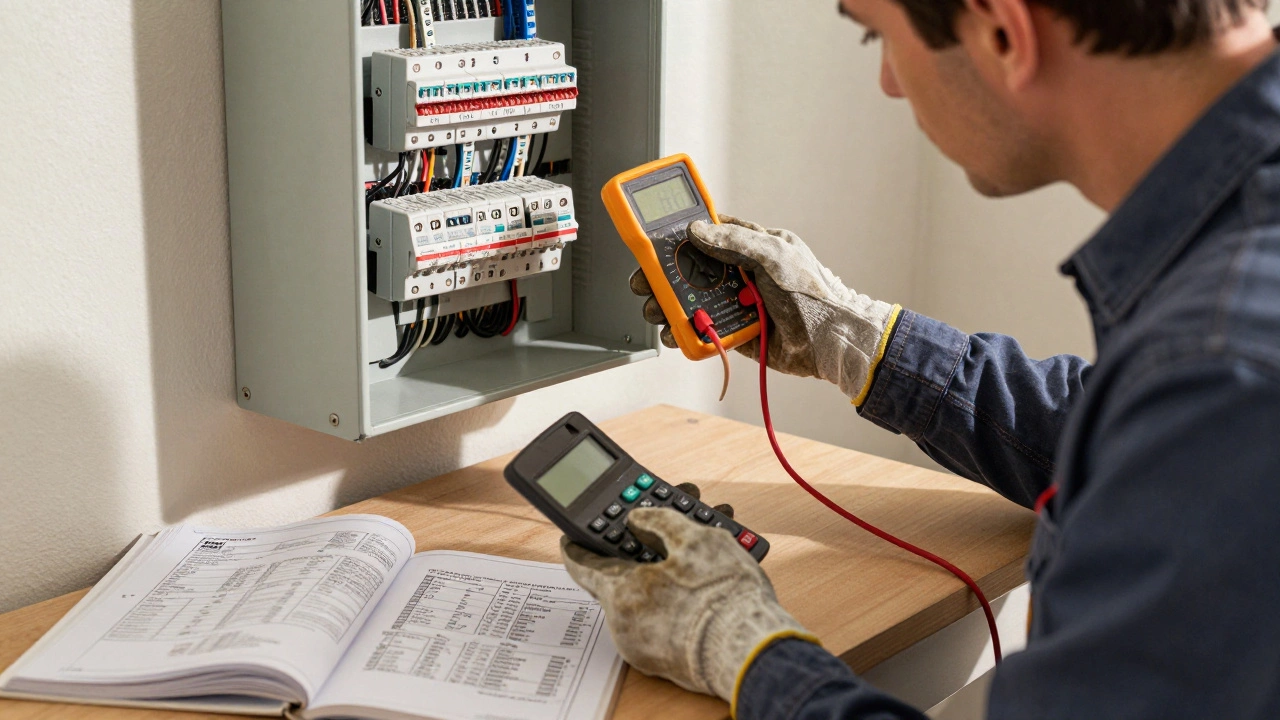
Ever seen an electrician reach for a calculator during a job and wondered if that’s all they need? It’s a common myth - that a calculator alone can turn someone into a skilled electrician. The truth? A calculator is just one tiny tool in a much bigger toolbox. You can’t wire a house, read blueprints, or troubleshoot a faulty circuit with just numbers on a screen. But if you know how to use math correctly, a calculator becomes powerful - not because it’s magic, but because it does the heavy lifting so you don’t have to.
Why Electricians Need Math - Not Just a Calculator
Electricians don’t just plug things in. They work with voltage, current, resistance, power, and load calculations every single day. These aren’t abstract classroom ideas - they’re life-or-death numbers. Get them wrong, and you risk fires, shocks, or equipment failure. That’s why the National Electrical Code (NEC) requires electricians to understand basic math.Let’s say you’re installing a new circuit for a kitchen appliance. You need to know how much current it draws. If the device is rated at 1,200 watts and runs on 120 volts, you can’t just guess. You need to calculate: amps = watts ÷ volts. That’s 1,200 ÷ 120 = 10 amps. Now you know you need a 15-amp breaker - not a 10-amp one. A calculator helps you do that fast. But if you don’t understand the formula, the calculator won’t save you.
It’s like using a GPS without knowing how to read a map. The device tells you where to turn, but if you don’t know the road system, you’ll end up lost. Same with electrical math. The calculator is your GPS. Your brain is the map.
What Calculations Do Electricians Actually Do?
Here are the five most common math tasks electricians handle daily:- Ohm’s Law: Voltage = Current × Resistance (V = I × R). Used to find missing values in a circuit.
- Power Formula: Power = Voltage × Current (P = V × I). Critical for sizing circuits and breakers.
- Wire Size Calculations: Based on amperage, distance, and material (copper vs. aluminum). NEC tables dictate minimum sizes.
- Load Calculations: Adding up all devices on a circuit to avoid overloading. This includes lighting, outlets, and appliances.
- Voltage Drop: How much power is lost over long wire runs. Too much drop = dim lights, motors overheating.
Each of these requires more than punching numbers into a calculator. You need to know which formula to use, what units to input, and how to interpret the result in real-world conditions. A calculator doesn’t tell you if a 12-gauge wire is enough for a 20-amp circuit over 150 feet - you need to check NEC Table 310.16 first.
What Tools Do Electricians Actually Use?
A calculator? Sure, sometimes. But here’s what’s actually in their belt:- Multimeter: Measures voltage, current, and resistance. Essential for testing live circuits.
- Clamp Meter: Measures current without breaking the circuit. Faster and safer than a regular multimeter.
- Wire Stripper and Cutter: Not a math tool, but critical for safe connections.
- Tape Measure and Level: For running conduit straight and at correct depths.
- Electrical Code Book: The NEC is over 800 pages long. No calculator replaces this.
- Smartphone Apps: Many pros now use apps like Electrical Calc or Ohm’s Law Calculator that auto-calculate wire size, voltage drop, and load. But even these require you to know what to input.
Think of it this way: A calculator is like a hammer. Useful. But you can’t build a house with just a hammer. You need saws, nails, drills, and blueprints too.

Can You Pass an Electrician License Exam With Just a Calculator?
In most states, you’re allowed a basic calculator during the journeyman or master electrician exam. But here’s the catch: the exam doesn’t test your calculator skills - it tests your understanding of electrical theory and code.For example, a question might ask: “A 240V heater draws 15 amps. What size overcurrent protection is required?”
You’d calculate: 15 × 1.25 = 18.75 → round up to 20 amps. But if you didn’t know the NEC rule that continuous loads need 125% of the rated current, you’d get it wrong - even if your calculator worked perfectly.
That’s why training programs spend weeks on math fundamentals before touching tools. You need to know why the math works before you can use it.
What Happens When You Skip the Math?
I’ve seen it too many times. A new apprentice tries to save time by guessing wire sizes or skipping load calculations. One time, a guy installed a 10-amp circuit for a 20-amp water heater. The breaker didn’t trip - because it was overloaded 100%. The wire overheated, insulation melted, and the outlet caught fire.That’s not a calculator failure. That’s a knowledge failure.
Electricity doesn’t care if you’re good at math. It only cares if the numbers are right. And when they’re not, it doesn’t warn you. It just burns.

How to Learn Electrical Math the Right Way
You don’t need to be a math genius. You need to learn three things:- Memorize the core formulas: V = I × R, P = V × I, P = I² × R. Practice them until they’re automatic.
- Understand NEC tables: Know how to read Table 310.16 (ampacity) and Table 220.55 (demand factors).
- Practice with real-world examples: Don’t just solve textbook problems. Take real appliance labels, circuit diagrams, and try calculating load, wire size, and breaker needs.
Many trade schools offer free electrical math workbooks. Use them. Do 10 problems a day. After a month, you’ll do calculations in your head - and your calculator will just be your backup.
Final Verdict: Can You Use a Calculator as an Electrician?
No. You can’t use a calculator as an electrician. But you absolutely need one as part of being an electrician.It’s not about the tool. It’s about the thinking behind it. A calculator can give you the right answer - but only if you ask the right question. And that? That comes from training, experience, and understanding the rules that keep people safe.
So if you’re thinking about becoming an electrician, don’t worry about buying the fanciest calculator. Worry about learning the math. Study the code. Practice until you don’t need to think about the formula anymore. That’s what turns a person with a tool into a professional who can trust their own hands.
Can I use a smartphone calculator during an electrician exam?
Yes, most licensing exams allow basic, non-programmable calculators - including smartphone calculators if they’re in exam mode (no internet, no memory storage). But you still need to know the formulas and code requirements. The calculator won’t help if you don’t know what to calculate.
Do I need a scientific calculator for electrical work?
Not necessarily. Most electrical math uses basic operations: addition, subtraction, multiplication, division, and square roots. A simple calculator works fine. What matters more is knowing which formula to use and how to apply it to real circuits. Some electricians use apps that auto-calculate wire size or voltage drop - these are more useful than a scientific calculator.
What’s the most important math skill for electricians?
Understanding Ohm’s Law and the power formula. These two rules cover 80% of daily calculations - sizing circuits, selecting breakers, checking voltage drop, and troubleshooting. If you master these, you’ll handle most real-world problems without stress.
Can I become an electrician if I’m bad at math?
You don’t need to be a math genius, but you do need to be willing to learn. Most people who struggle with math in electrician school improve quickly with daily practice. Start with simple problems, use flashcards, and work through real examples. Within a few weeks, the numbers start making sense. Many top electricians weren’t good at math - they just practiced until they were.
Do electricians use calculators on the job every day?
Not always. Many calculations are done from memory or from pre-loaded apps. But when installing new circuits, adding loads, or troubleshooting unusual systems, they’ll use a calculator or app to double-check. It’s not about using it constantly - it’s about knowing you can rely on it when precision matters.
Leave a comments