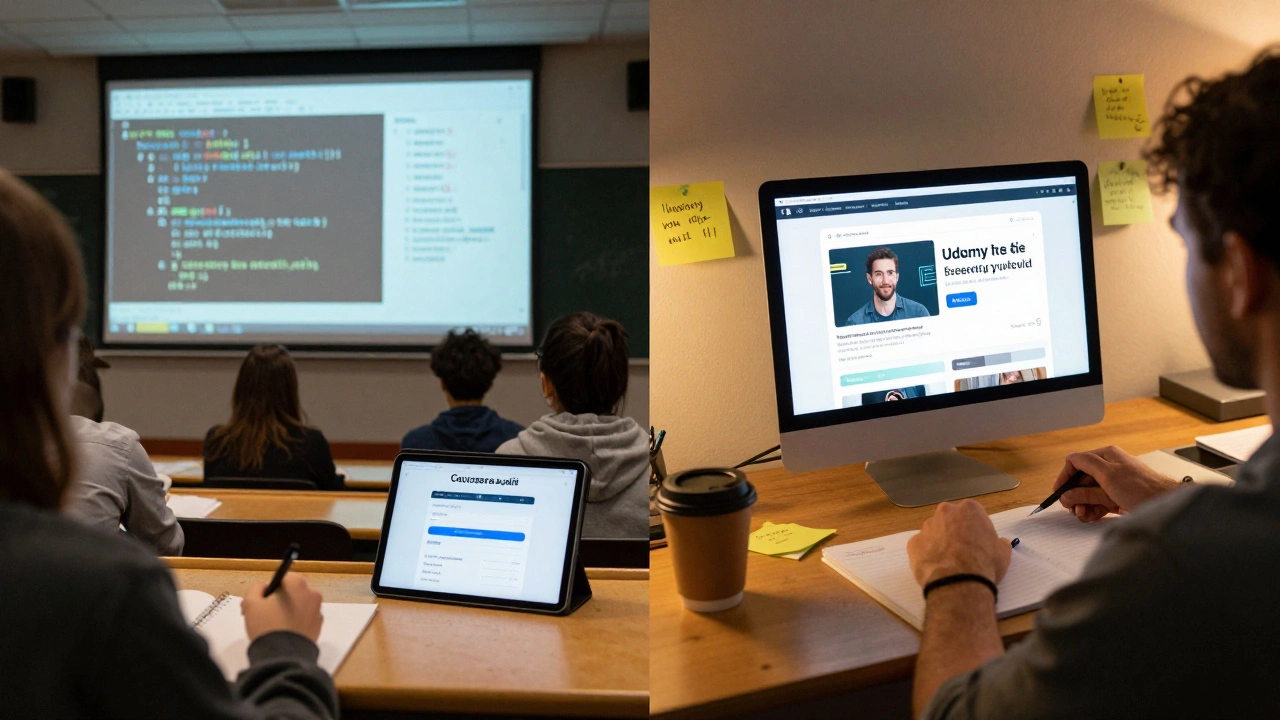
When you're looking to learn a new skill without spending a dime, Coursera and Udemy are the two names that come up most often. But they’re not the same. One feels like a university lecture hall. The other feels like a garage sale of knowledge. Which one actually gives you more for free? The answer isn’t simple - it depends on what you want to learn, how you learn best, and what you plan to do with that knowledge after.
What You Get for Free on Coursera
Coursera partners with universities like Stanford, Yale, and the University of London. That means the content isn’t just random videos uploaded by someone with a microphone. It’s structured syllabi, peer-reviewed assignments, and sometimes even graded exams. If you sign up for a course without paying, you still get access to all the video lectures and readings. That’s a big deal.
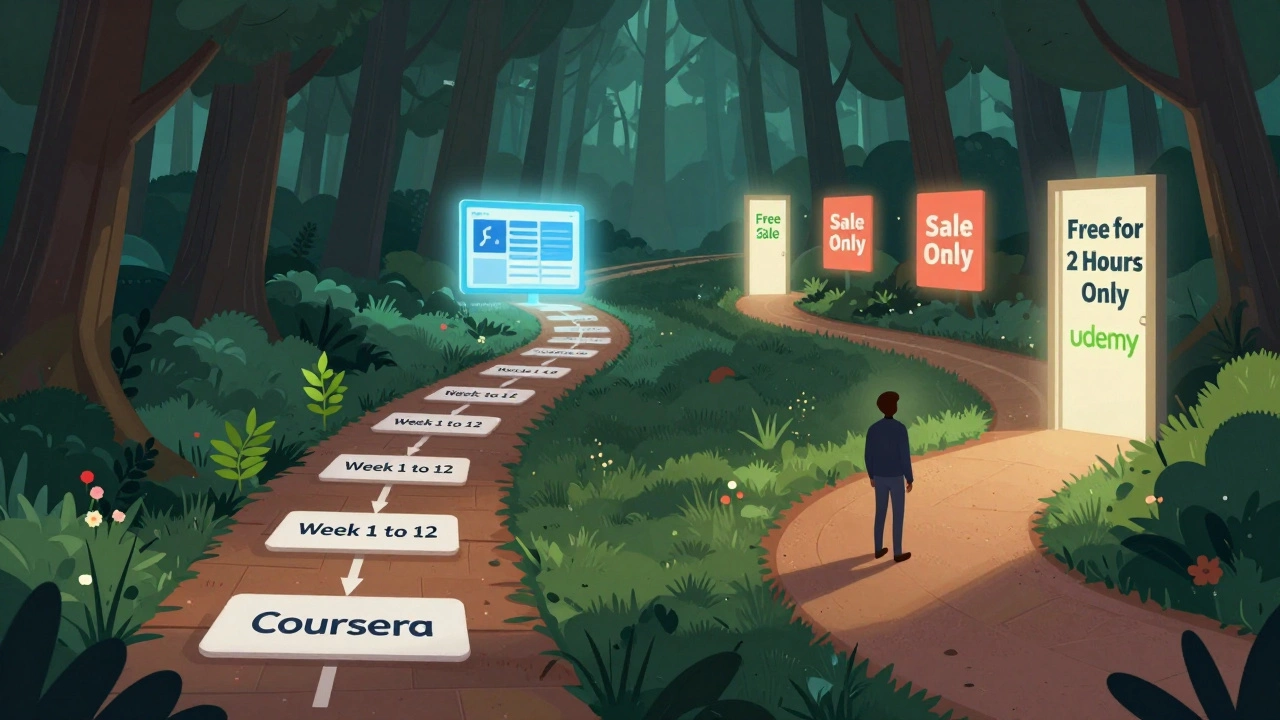
For example, if you take the free version of “Python for Everybody” from the University of Michigan, you’ll get all 12 weeks of video lessons, quizzes, and coding exercises. You just won’t get a certificate at the end - unless you pay $49. But here’s the catch: many employers don’t care about the certificate. They care if you can actually code. And with Coursera’s free access, you can build real projects using Python, SQL, or data analysis tools - all without opening your wallet.
There’s also the “Audit Mode” option. It’s not hidden. It’s right there on every course page. Click it, and you’re in. No credit card needed. No trial period. No upsell until you’re done. That’s rare in the online learning world.
What You Get for Free on Udemy
Udemy is different. It’s a marketplace. Anyone can create a course. That means quality varies wildly. But it also means you can find niche skills you won’t see anywhere else - like how to fix a leaky faucet using only duct tape and a wrench, or how to edit TikTok videos with free apps.
Udemy doesn’t have a true “free access” model like Coursera. Instead, they give away free courses - sometimes hundreds at a time - as promotions. These aren’t limited to beginners. You can find free courses on machine learning, UX design, and even financial modeling. But here’s the problem: they disappear fast. A course that’s free today might cost $20 tomorrow. You have to act quickly.
There are websites and Reddit threads that track Udemy’s free offers. But if you’re not checking daily, you’ll miss out. And once the free offer ends, you’re locked out. No audit mode. No partial access. Either you paid, or you didn’t learn.
Course Structure: University vs Marketplace
Coursera courses are built like college classes. There’s a weekly schedule. Deadlines. Discussion boards. Peer feedback. It’s designed to keep you on track. That’s great if you need structure. But if you’re juggling a full-time job or kids, it can feel overwhelming.
Udemy is the opposite. Every course is self-paced. You can finish a 10-hour course in one weekend. Or drag it out over six months. No pressure. No due dates. That freedom is powerful - if you’re self-motivated. But if you’ve ever started a fitness plan and quit after two weeks, you know how easy it is to let “I’ll do it later” become “I’ll never do it.”
Here’s a real example: two people want to learn Excel. One picks Coursera’s “Excel Skills for Business” series. They complete all four courses over three months. They submit assignments. They get feedback. They build a real budget spreadsheet. The other picks a free Udemy course called “Excel for Beginners (Free)”. They watch the first two videos. They get distracted. They forget about it. Six months later, they still can’t use VLOOKUP.
Who’s the Instructor?
Coursera’s instructors are professors, researchers, or industry experts with formal credentials. You know who they are. You can Google them. You’ll find their academic papers or LinkedIn profiles. That builds trust.
On Udemy, instructors are often anonymous. You might see a name like “John D. Tech” with a photo of a guy holding a laptop. No bio. No credentials listed. No way to verify if they’ve ever used the tool they’re teaching. Some are amazing. Some are just repackaging YouTube tutorials. You have to read reviews - and look for ones with screenshots or project files.
One Udemy course on digital marketing had 4,000 reviews - but 80% of them said, “This is just copied from HubSpot’s blog.” That’s not a red flag. It’s a warning.
Free Certificates: Do They Matter?
Coursera doesn’t give you a certificate for free. But you can still list the course on your LinkedIn or resume. You can say: “Completed Python for Everybody - University of Michigan (Audit).” Employers don’t always ask for proof. They ask: “Can you show me what you built?”
Udemy gives you a certificate - but only if you paid. The free ones? No certificate. That’s a problem if you’re job hunting. A certificate, even from a random instructor, looks better on a resume than nothing. But it’s not worth paying $15 for a course that’s just a 30-minute walkthrough.
Real talk: certificates don’t get you hired. Skills do. And you can build skills without a certificate on either platform.
What You Can Learn for Free
Coursera is better for:
- Academic subjects: statistics, psychology, economics
- Technical foundations: programming, data science, cloud computing
- Structured learning: if you need deadlines and assignments to stay on track
Udemy is better for:
- Niche tools: Canva, Notion, Figma, Adobe Express
- Quick wins: how to write a resume, how to negotiate salary, how to start a side hustle
- Hands-on skills: video editing, photography, basic home repair
If you want to learn how to use Google Sheets to track your monthly expenses? Udemy has a 45-minute course for free right now. If you want to understand how credit scores work? Coursera has a 6-week course from a top university - free.
Which One Should You Pick?
Here’s the shortcut:
If you’re trying to get a job in tech, data, or business - start with Coursera. Build a portfolio of projects. Show employers you can apply what you learned.
If you’re trying to pick up a practical skill fast - like learning to design social media posts or fix your Wi-Fi router - go to Udemy. Search for “free” courses. Read the reviews. Download the project files. Do the exercise. Then move on.
And here’s the truth: you don’t have to choose one. Use Coursera to build depth. Use Udemy to fill in the gaps. A lot of people do. They take a Coursera course on data analysis, then find a Udemy course on Tableau visualization to go deeper.
Free Isn’t Always Better
Free courses can be a trap. They’re easy to start. Hard to finish. That’s why most people never complete them.
Here’s what actually works: pick one course. Set a goal. “I will finish this in 30 days.” Block out 30 minutes every morning. Do it before coffee. Don’t jump to the next course until you’re done. That’s how people who learn for free actually get results.
Neither Coursera nor Udemy will teach you discipline. You have to bring that yourself.
Final Tip: Use Both, But Strategically
Bookmark Coursera’s free course page. Check it once a week. You’ll find new offerings from top schools every month.
Subscribe to Udemy’s free course newsletter. Or follow r/UdemyFreebies on Reddit. Set a calendar alert: “Check Udemy free offers every Friday at 6 PM.”
One person used this system for six months. They learned Python, Excel, project management, and basic graphic design - all for free. They got promoted at work. Not because of certificates. Because they built a portfolio of real work.
It’s not about which platform is better. It’s about which one helps you start - and stick with it.
Can I get a certificate for free on Coursera?
No, Coursera doesn’t give free certificates. But you can audit courses for free and still learn everything. The certificate only proves you paid - not that you learned. Employers care more about your projects than your paper.
Are Udemy free courses really free forever?
No. Udemy’s free courses are temporary promotions. They can disappear in hours or days. If you find one you like, enroll immediately. Otherwise, you’ll lose access when the offer ends. There’s no way to get it back for free.
Which platform has better content quality?
Coursera generally has higher quality because courses are created by universities and vetted by academics. Udemy’s quality varies - some courses are excellent, others are low-effort copies of YouTube videos. Always check instructor credentials and student reviews before starting.
Can I use Coursera and Udemy together?
Yes. Many learners use Coursera for foundational knowledge and Udemy for quick, practical skills. For example, take a Coursera course on machine learning, then use a Udemy course to learn how to deploy models with Python libraries. Combining both gives you depth and speed.
Do I need to pay for anything to start learning?
No. You can start learning on both platforms without paying. Coursera lets you audit courses with full access to videos and readings. Udemy offers free courses as limited-time promotions. You only pay if you want a certificate or access to a paid course.
Leave a comments