
Degree vs Diploma Cost & Earnings Calculator
Compare Your Education Path
When you finish 12th grade in India, one of the first big decisions you face is: should you go for a degree or a diploma? It’s not just about what looks better on paper. It’s about time, money, and where you want to be in three or five years. Many students feel pressured to pick a degree because it’s seen as the "normal" path. But that doesn’t mean it’s the right one for everyone.
What’s the real difference between a degree and a diploma?
A degree, like a B.A., B.Sc., or B.Tech, usually takes three to four years. It’s broad. You study theory, some practical work, and a lot of exams. It’s designed to give you a wide foundation in a subject - think physics, economics, or computer science. Degrees are often tied to universities and follow strict syllabi set by bodies like UGC or AICTE.
A diploma, on the other hand, is shorter. Most last one to three years. It’s focused. You learn how to do something - fix a car, code an app, run a kitchen, install electrical systems. The goal isn’t to make you a scholar. It’s to make you job-ready. Diplomas are offered by polytechnics, ITIs, and private institutes approved by NCVT or SCVT.
The biggest difference? A degree prepares you to think. A diploma prepares you to do.
Cost and time: The hidden advantages of diplomas
Let’s talk numbers. A four-year engineering degree at a private college in India can cost anywhere from ₹6 lakh to ₹20 lakh. Even a government college might charge ₹2-4 lakh. Add living expenses, books, and transport, and you’re looking at ₹10-25 lakh total.
A three-year diploma in mechanical engineering? Around ₹30,000 to ₹1.5 lakh, depending on the institute. Many government polytechnics charge less than ₹50,000 for the entire course. You’re saving 80-90% of the cost. And you finish in half the time.
That means you can start earning earlier. A diploma holder in IT or electrical trades often gets hired right after graduation. In 2024, the National Sample Survey found that 68% of diploma graduates in technical fields found jobs within six months. Degree holders in non-engineering fields? Only 42% did the same.
Job market reality: Who’s hiring who?
Here’s something many students don’t realize: companies don’t always care if you have a degree. They care if you can do the job.
Take the construction industry. Contractors don’t hire civil engineers to lay bricks. They hire diploma holders in civil technology - people who know how to read blueprints, operate machinery, and manage site teams. Same with hospitals: they hire diploma-trained nurses and lab technicians, not degree holders with no hands-on experience.
Even in tech, companies like TCS, Infosys, and Wipro hire diploma holders for entry-level roles in network support, software testing, and hardware maintenance. In fact, many IT firms run internal training programs specifically for diploma graduates because they’re quicker to train and more practical.
And don’t forget government jobs. SSC, RRB, and state-level recruitments have separate categories for diploma holders. You can apply for positions like Junior Engineer, Technician, or Supervisor - roles that pay ₹25,000 to ₹40,000 per month right after graduation. A B.Tech graduate might need to wait for higher-level posts that require competitive exams like GATE.
Can you switch from diploma to degree later?
Yes. And that’s one of the biggest advantages of choosing a diploma first.
After completing a three-year diploma in engineering, you can enter the second year of a B.Tech program through lateral entry. That’s called a "lateral entry scheme" - and it’s available in almost all states. You save one year of study and tuition, and still end up with a degree.
Same goes for non-engineering diplomas. A diploma in hotel management lets you join the second year of a BHM. A diploma in nursing opens the door to a B.Sc. Nursing. Many universities even offer part-time or distance degree options for working diploma holders.
This flexibility means you don’t have to lock yourself into one path. You can test the waters, earn money, and then decide if you want to go further.

What about prestige? Isn’t a degree "better"?
Society still gives more weight to degrees. Parents, relatives, even some employers assume a degree = smarter, more serious, more successful. But that’s changing - slowly.
In urban areas, companies are more focused on skills. In rural and semi-urban areas, diploma holders are often preferred for technical roles because they’re cheaper to hire and more reliable on the ground. A 2023 report by NASSCOM showed that 57% of IT firms in Tier 2 and Tier 3 cities hired more diploma holders than degree holders for technical support roles.
Also, consider this: many successful entrepreneurs in India started with a diploma. Think of people who run auto repair shops, electrician businesses, or digital marketing agencies. They didn’t need a degree. They needed skills, grit, and a good network.
So prestige is real - but it’s not always practical. And it’s not permanent. Once you start earning, building experience, and proving your value, your diploma becomes irrelevant. What matters is what you’ve done since.
When is a degree the better choice?
It’s not all about diplomas. There are clear cases where a degree makes more sense.
- If you want to become a doctor, lawyer, chartered accountant, or architect - you need a degree. These are regulated professions with legal requirements.
- If you plan to work in research, academia, or government services like IAS/IPS - a degree is mandatory. Most UPSC exams require a bachelor’s.
- If you’re aiming for corporate jobs in HR, finance, or marketing at big firms - a degree often opens the first door. Many companies still use degrees as a filter for campus placements.
Also, if you’re planning to study abroad, most countries require a 12+4 education structure. A diploma alone won’t get you into a Master’s program overseas.
What should you do if you’re unsure?
Start with this: Ask yourself three questions.
- Do I want to work with my hands, tools, or machines - or with people, data, and theory?
- Can I afford to wait four years without earning? Or do I need income sooner?
- Am I aiming for a specific job that requires a degree - or can I get there with skills?
If you’re unsure, go for a diploma. It’s lower risk. You can always upgrade later. But if you start a degree and realize you hate the theory, or can’t afford it, you’re stuck - with debt and no clear path forward.
Also, talk to people already working in the field you’re interested in. Ask them: "Did you need a degree to get here?" or "Would you recommend a diploma?" Real answers from real workers beat advice from parents or YouTube influencers.
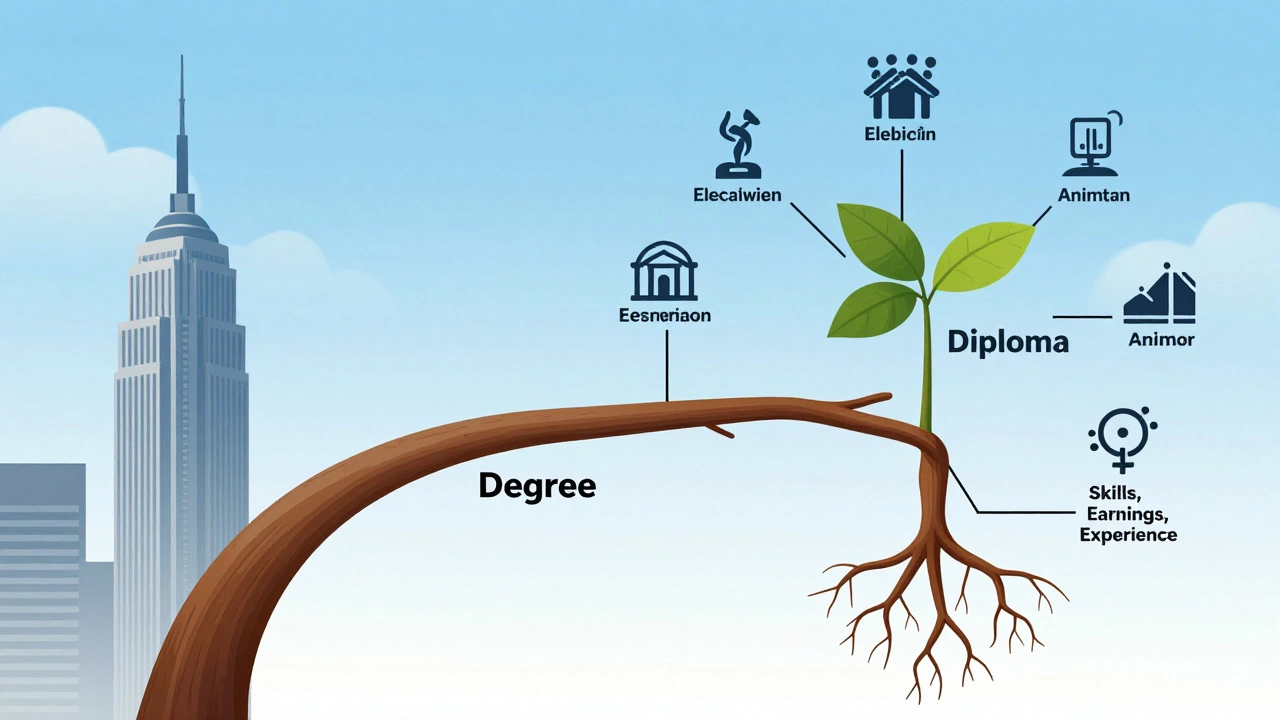
Top diploma courses in India with strong job returns (2025)
Here are some high-demand diploma courses in India right now, with average starting salaries:
| Diploma Course | Duration | Typical Employers | Avg. Starting Salary (₹/month) |
|---|---|---|---|
| Diploma in Computer Engineering | 3 years | IT firms, startups, BPOs | 18,000-28,000 |
| Diploma in Electrical Engineering | 3 years | Power companies, factories, construction | 20,000-30,000 |
| Diploma in Medical Lab Technology | 2 years | Hospitals, diagnostic centers | 15,000-25,000 |
| Diploma in Animation & VFX | 2 years | Media houses, game studios | 16,000-25,000 |
| Diploma in Hospitality Management | 1-3 years | Hotels, resorts, airlines | 14,000-22,000 |
| Diploma in Digital Marketing | 6-12 months | Agencies, e-commerce firms | 15,000-25,000 |
| Diploma in Automobile Engineering | 3 years | Manufacturers, service centers | 18,000-26,000 |
Notice something? Many of these courses take less than three years. Many pay better than entry-level degree jobs in arts or commerce.
Bottom line: Choose based on your goals, not pressure
There’s no universal answer to "degree or diploma?" It depends on your situation, your goals, and your resources.
If you want to work fast, earn early, and learn by doing - go for a diploma. You’ll be employed before many degree students even finish their first year.
If you want to climb corporate ladders, enter regulated professions, or study abroad - a degree is necessary. But even then, you can start with a diploma and upgrade later.
Don’t let tradition or social pressure make your choice for you. The job market doesn’t care about your certificate. It cares about your skills, your attitude, and what you’ve built since.
There’s no shame in a diploma. In fact, in India’s growing economy, skilled workers are in more demand than ever.
Is a diploma equal to a degree in India?
No, a diploma is not equal to a degree in terms of academic level. A degree is a higher qualification - typically three to four years after 12th grade. A diploma is shorter, more practical, and usually taken after 10th or 12th grade. But in the job market, especially for technical roles, many employers treat them as equally valid entry points. You can even use a diploma to enter the second year of a degree program.
Can I get a government job with a diploma?
Yes, absolutely. Many government jobs in railways, public works, electricity boards, and state PSUs specifically hire diploma holders for roles like Junior Engineer, Technician, and Supervisor. SSC, RRB, and state-level exams have separate categories for diploma candidates. In fact, diploma holders often have higher selection rates in these exams because there’s less competition than for graduate-level posts.
Which is cheaper: diploma or degree?
A diploma is significantly cheaper. A three-year diploma in a government polytechnic costs ₹30,000-₹1.5 lakh total. A four-year degree at a private college can cost ₹10-25 lakh. Even government engineering colleges charge ₹2-4 lakh. That’s a 70-90% difference in cost. Plus, diploma holders start earning a year or two earlier, making the financial return much faster.
Do companies hire diploma holders over degree holders?
Yes, especially in technical, skilled, and hands-on roles. Companies like Tata Motors, Reliance, L&T, and IT firms hire diploma holders for maintenance, field service, testing, and operations. These roles don’t need deep theory - they need people who can fix things, run machines, or support systems. Many firms even prefer diploma holders because they’re trained for real-world tasks from day one.
Can I do a degree after a diploma?
Yes, and it’s one of the smartest moves. After completing a three-year diploma in engineering, you can join the second year of a B.Tech through lateral entry. The same applies to diplomas in management, nursing, and design. Many universities offer part-time and distance degrees for working diploma holders. This way, you save time and money, and still get the degree credential later.
Are diploma courses recognized internationally?
Most international universities don’t accept Indian diplomas as direct entry to a Bachelor’s. But many countries recognize them for vocational training and skilled worker visas. For example, Canada and Australia have pathways for skilled tradespeople with diploma-level qualifications. If you plan to study abroad, you’ll likely need to complete a degree first. But if you plan to work abroad in a technical field, your diploma can be valuable.
What’s next?
Don’t wait for someone to tell you what to do. Research the job you want. Look at job postings on Naukri or LinkedIn. See what qualifications they ask for. Talk to people in that field. Visit a local polytechnic or ITI. Ask about placements.
The path that looks "safe" isn’t always the best. Sometimes, the smarter move is the one no one else is taking.
Leave a comments