Career Path Finder: Diploma vs Degree
Answer a few questions to see which educational route aligns best with your professional goals and current situation.
What is your primary goal right now?
Your Recommended Path
Quick Summary of Key Differences
- Nature: Degrees are academic and theoretical; diplomas are technical and practical.
- Duration: Degrees usually take 3-4 years; diplomas range from 1 to 3 years.
- Entry Point: Degrees usually require a higher secondary certificate; diplomas can start after 10th or 12th grade.
- Goal: Degrees prepare you for diverse roles and higher research; diplomas prepare you for a specific trade or role.
The Fundamental Split: Academic vs. Vocational
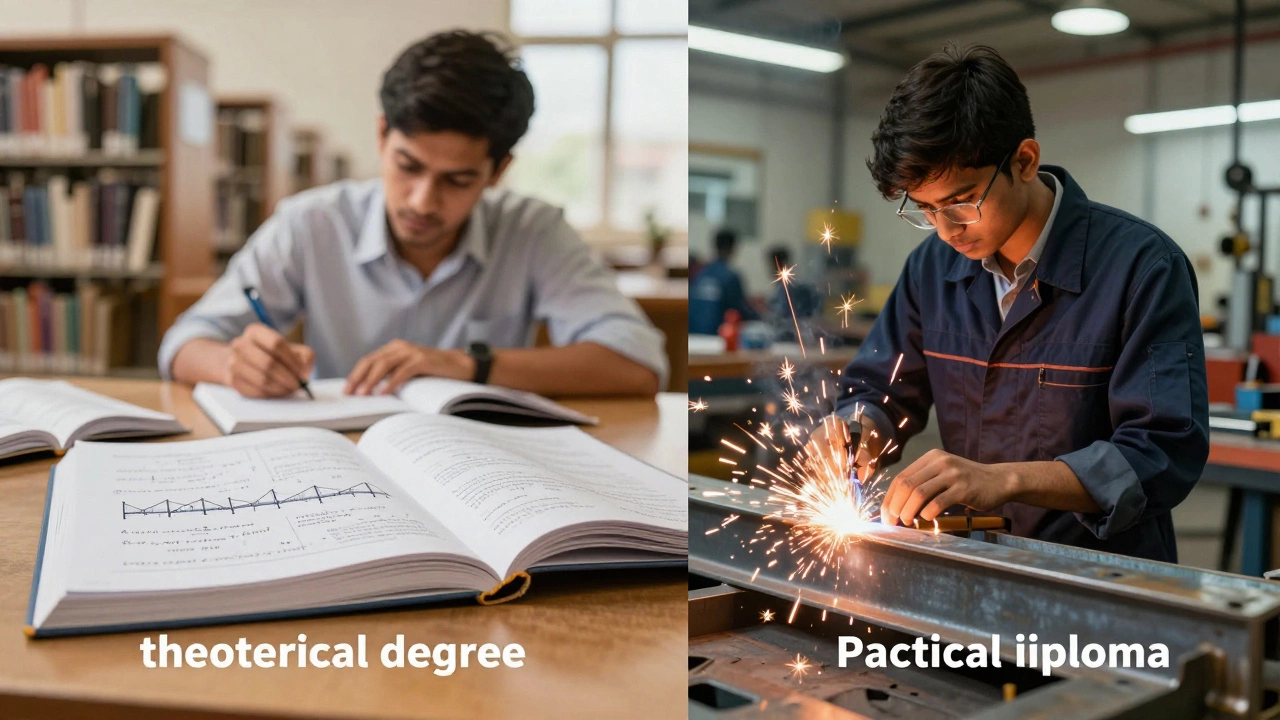
To understand why a diploma isn't a degree, you have to look at what they are trying to achieve. A degree, like a B.Tech or a B.A., is designed to give you a deep understanding of a subject. You spend a lot of time studying the "why" behind things. For example, an engineering degree student spends months calculating the physics of stress and strain on a bridge before they even think about building a model.A Diploma, on the other hand, is built for speed and utility. If that same student was in a polytechnic diploma course, they'd spend more time in the workshop learning how to actually weld the beams or use the machinery. The goal is to get you into the workforce as quickly as possible. This is why diplomas are often categorized under vocational training-they provide the specific skills a company needs to fill a gap on the factory floor or in a technical office.
Who Regulates These Qualifications?
In India, the governing bodies are different, which is why the titles aren't interchangeable. Degrees are governed by the University Grants Commission (UGC), which ensures that the academic standards of universities across the country are consistent. If you have a degree from a UGC-recognized university, you're essentially certified as a graduate.Diplomas, especially technical ones, usually fall under the AICTE (All India Council for Technical Education) or state-level boards of technical education. These bodies care more about the curriculum's relevance to current industry standards than about academic theory. If you're choosing a course, always check if the institution is AICTE approved. Without this, your diploma might be useless when applying for government jobs through the Staff Selection Commission (SSC) or state public service commissions.
| Feature | Diploma | Degree |
|---|---|---|
| Core Focus | Practical Application/Skills | Theoretical Knowledge/Research |
| Average Duration | 1 to 3 Years | 3 to 4 Years |
| Minimum Eligibility | 10th or 12th Standard | 12th Standard (Higher Secondary) |
| Governing Body | AICTE / State Boards | UGC / Universities |
| Career Path | Technician, Supervisor, Specialist | Manager, Engineer, Academic, Consultant |
Can You Turn a Diploma Into a Degree?
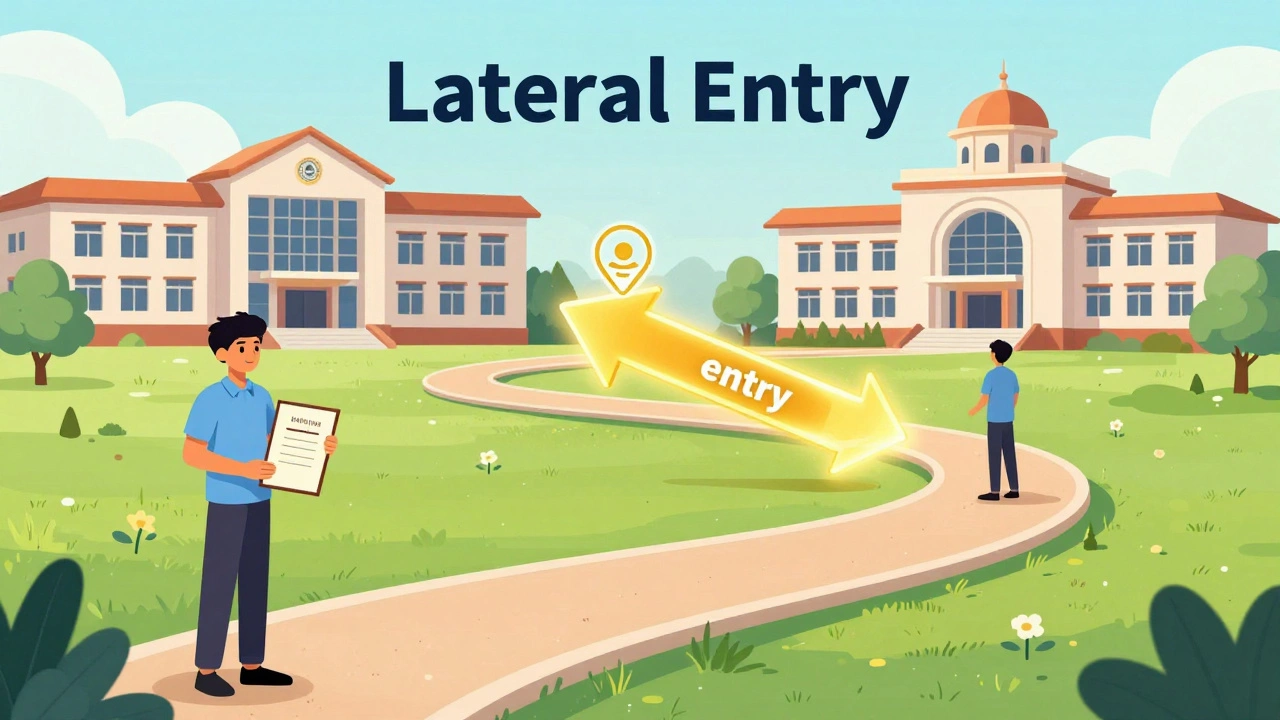
One of the biggest misconceptions is that choosing a diploma is a "dead end." In reality, it's often a shortcut. In India, there is a system called Lateral Entry. This is a game-changer for students who start with a diploma in engineering (Polytechnic).Here is how it works: if you complete a three-year diploma in a technical field, you don't have to start a B.Tech degree from the first year. You can apply for lateral entry directly into the second year of the degree program. This means you spend three years on your diploma and then three years on your degree. You end up with both a practical foundation and a formal degree, which often makes you more employable than someone who only did the degree. You've seen the machines and the math.
Impact on Jobs and Salaries
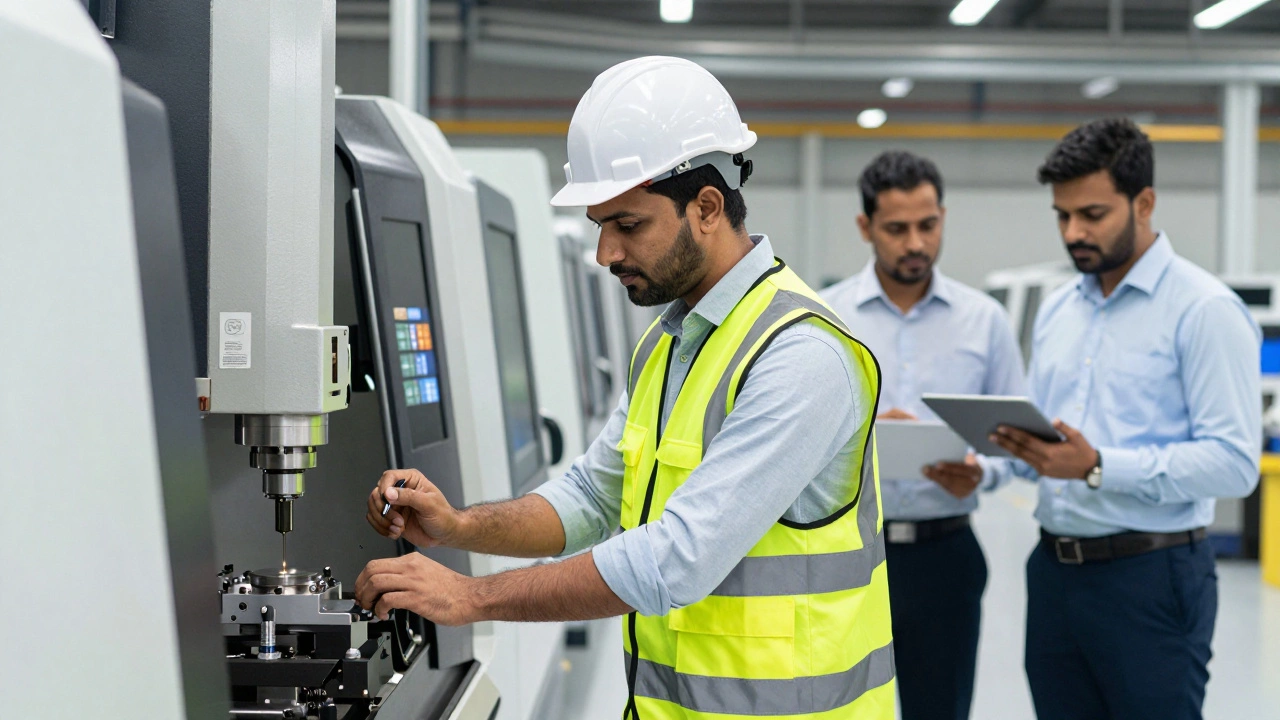
Will you get paid the same? Usually, no. In the Indian job market, especially in the public sector, there is a clear pay scale difference between a "Graduate" and a "Diploma Holder." A degree holder is typically entered at a higher grade and has a higher salary ceiling.However, the job search experience is different. Someone with a diploma in Mechanical Engineering might find it easier to get an entry-level role as a Junior Engineer or a Technician because they can actually operate the equipment. A degree holder might struggle if they have zero practical experience and only know the formulas. In the private sector, companies like Tata Motors or Reliance Industries value diplomas for their operational roles, while they reserve degrees for design and management roles.
Common Types of Diplomas in India
Not all diplomas are created equal. You'll find a massive variety depending on your goals:- Polytechnic Diplomas: These are the most common 3-year courses in Civil, Mechanical, or Electrical engineering. They are the gold standard for technical roles.
- PG Diplomas (PGD): These are taken *after* a degree. For example, a PGD in Management or Data Science. These act as a specialization tool to make a general degree more marketable.
- Vocational Diplomas: Shorter courses focusing on specific trades like HVAC, plumbing, or fashion design. These are often linked to the National Skill Development Corporation (NSDC) framework.
Pitfalls to Avoid When Choosing
Don't fall for the "Global Diploma" trap. You'll see many private institutes offering "International Diplomas" that promise high salaries. Be careful. If the course isn't recognized by the UGC or AICTE, you might find that government portals won't even let you upload your certificate during job applications.Also, consider the "Academic Gap." If you take a diploma and decide not to pursue a degree, you are essentially capping your growth in some corporate hierarchies. Some companies have a hard rule: to move from "Senior Technician" to "Manager," you must have a degree. If that's your long-term goal, keep the lateral entry path in mind.
Is a diploma considered a graduation in India?
No, a diploma is not considered graduation. In India, "graduation" specifically refers to completing a bachelor's degree from a recognized university. A diploma holder is considered a "technical graduate" or a "diploma holder," but for eligibility in most government exams (like UPSC or State PSC), they do not meet the "graduate" criteria unless specified.
Can I do a Master's degree after a diploma?
Generally, no. You cannot jump straight from a diploma to a Master's (like an M.Tech or MBA). You first need to complete a Bachelor's degree. However, you can use lateral entry to finish your degree faster and then proceed to postgraduate studies.
Which is better for a career: Diploma or Degree?
It depends on your goal. If you want to start working quickly and prefer hands-on technical work, a diploma is better. If you want to enter management, research, or high-level engineering design, a degree is essential. Many of the most successful engineers in India start with a diploma and then get a degree via lateral entry.
Are diploma courses cheaper than degrees?
Yes, typically they are. Because they are shorter and often funded by state governments through polytechnic colleges, the tuition fees for diplomas are usually significantly lower than those for a 4-year B.Tech or B.E. degree.
Can I get a government job with only a diploma?
Absolutely. There are thousands of roles for Junior Engineers (JE) in departments like the Indian Railways, PWD, and State Electricity Boards that specifically require a diploma. In some cases, diploma holders are preferred over degree holders for these specific operational roles.
What Should You Do Next?
If you're still undecided, start by mapping your 5-year plan. Do you want to be the person who manages the project, or the person who knows exactly how to fix the machine when it breaks?For those who are unsure, starting with a polytechnic diploma is a low-risk move. It gives you a professional qualification in three years. If you love the work, you can jump into a job. If you find you want more theoretical depth, the lateral entry path to a degree is always there. Just remember to verify the accreditation of the college-whether it's a state board or the AICTE-before paying any admission fees.
Leave a comments