
Trade School ROI Calculator
Select Your Trade
Your Specifics
Investment Analysis
Standing in front of a list of trade schools can feel like standing in front of a wall of noise. You see ads for electrician programs, plumbing certifications, and HVAC diplomas, but which one actually fits your life? The wrong choice costs you thousands of dollars and months of time. The right choice gets you a paycheck that often beats a four-year degree salary within two years.
You don't need a crystal ball to pick the right path. You need a clear map of what you want out of work, how much risk you can handle, and which skills are actually in demand where you live. This guide cuts through the marketing fluff and gives you a practical framework to evaluate any vocational program before you sign up.
The Quick Reality Check: What Do You Actually Want?
Before you look at tuition fees or campus tours, you need to be honest about your daily preferences. Trade jobs are not just "jobs." They are lifestyles. If you hate getting your hands dirty, a plumbing apprenticeship will feel like punishment, no matter how good the pay is.
Ask yourself these three questions:
- Do I prefer physical labor or technical precision? Physical trades like carpentry or roofing require stamina and strength. Technical trades like elevator repair or medical assisting require fine motor skills and attention to detail.
- Can I handle irregular hours? Emergency trades like locksmithing or electrical repair often mean night shifts, weekends, and holiday calls. Office-based trades like drafting or IT support usually offer standard 9-to-5 schedules.
- Do I want to work alone or on a team? Some roles, like commercial painting, are often solo or small-team gigs. Others, like construction management or large-scale HVAC installation, require constant coordination with dozens of people.
Your answers here narrow down your options faster than any ranking list could. A "best" school is useless if it teaches a trade you hate doing every day.
Decoding Accreditation: Why It Matters More Than Rankings
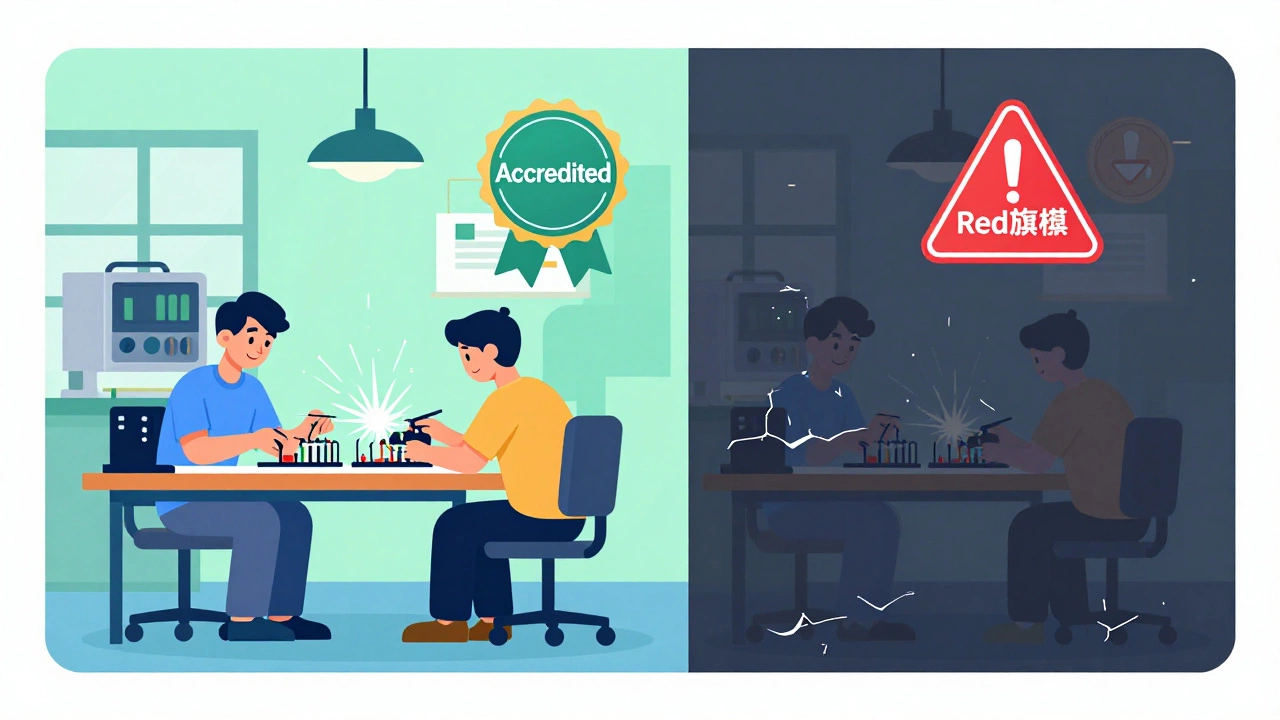
You’ve probably seen websites claiming their school is "top-rated" or "#1 in the state." Ignore those. Instead, look for accreditation. This is the single most important factor in choosing a vocational program.
Accreditation means an independent body has reviewed the curriculum, facilities, and outcomes of the school. In the United States, look for regional accreditation (like MSCHE or WSCUC) or specialized professional accreditation (like ABET for engineering tech or ARC-PA for nursing). Without this stamp, your diploma might not be recognized by employers, and you won’t qualify for federal financial aid.
Here’s the catch: many private trade schools use aggressive marketing to hide weak accreditation status. Always verify the school’s status directly on the accrediting agency’s website, not on the school’s own page. If a school pressures you to enroll before you can check this, walk away.
Cost vs. Return: The Math That Doesn’t Lie
Trade schools vary wildly in price. A community college welding program might cost $3,000 for a semester. A private culinary institute could charge $40,000 for a year. How do you decide?
Calculate the Return on Investment (ROI). Take the total cost of the program (tuition + tools + books + lost wages while studying) and divide it by the average starting salary in your area for that role. Then, subtract the cost from the first year’s salary. If the number is negative or close to zero, the program is likely overpriced.
| Trade | Avg. Program Cost | Avg. Starting Salary | Payback Period |
|---|---|---|---|
| Electrician | $8,000 - $15,000 | $45,000 - $55,000 | 3-6 months |
| HVAC Technician | $5,000 - $12,000 | $40,000 - $50,000 | 3-5 months |
| Culinary Arts | $15,000 - $40,000 | $25,000 - $35,000 | 12-24 months |
| Welding | $3,000 - $8,000 | $35,000 - $45,000 | 2-4 months |
Note that salaries vary heavily by location. An electrician in New York City earns significantly more than one in rural Ohio. Always research local wage data using the Bureau of Labor Statistics (BLS) Occupational Outlook Handbook.
Government Support: Grants and Apprenticeships
You don’t have to pay full price. Many students overlook government-funded opportunities because they assume they’re only for university-bound scholars. That’s a mistake.
In the U.S., the Federal Pell Grant is available for eligible students attending accredited trade schools. Additionally, many states offer workforce development grants specifically for high-demand trades like healthcare, renewable energy, and advanced manufacturing. These grants often cover 100% of tuition if you commit to working in that field for a set period after graduation.
Apprenticeships are another goldmine. Programs like those offered by the U.S. Department of Labor allow you to earn money while you learn. You work under a journeyman for three to five years, receiving paid training and classroom instruction. By the end, you have a certification, debt-free, and often a guaranteed job.
Location and Job Market: Don’t Train in a Vacuum
A great school in a dead market is still a bad investment. Before enrolling, research the local demand for your chosen trade.
Use tools like LinkedIn Jobs, Indeed, and local union websites to see how many openings exist for entry-level positions in your city or region. If there are fewer than five postings per month, consider whether you’re willing to relocate. Some trades, like wind turbine technician or solar panel installer, are booming in specific regions but scarce in others.
Also, check if the school has partnerships with local employers. Schools with strong industry connections often host job fairs, offer internships, and have alumni networks that help graduates land their first roles. Ask the admissions counselor: "What percentage of your graduates get hired within six months?" If they can’t give you a number, that’s a red flag.

Hands-On Time: The Heart of Trade Education
Trade skills are learned by doing, not by reading. When evaluating a program, ask about the ratio of classroom time to shop time. For most skilled trades, you should spend at least 70-80% of your time in workshops, labs, or on-site training.
Visit the facility. Look at the equipment. Is it modern? Are there enough stations for every student to practice simultaneously? If you’re learning to weld on outdated machines or practicing electrical wiring on simulated panels instead of real circuits, you’ll struggle when you enter the real world.
Talk to current students. Ask them: "Did you feel prepared for your internship?" Their honest feedback will tell you more than any brochure ever could.
Red Flags: Signs to Walk Away
Not all trade schools are created equal. Here are warning signs that a program might not be worth your time or money:
- High-pressure sales tactics: Admissions counselors who pressure you to sign up immediately or promise guaranteed jobs without mentioning effort.
- Vague job placement rates: Schools that claim "90% placement" but don’t define what that means (e.g., includes part-time, unrelated jobs).
- Lack of transparency: Reluctance to provide detailed cost breakdowns or curriculum outlines.
- Outdated curriculum: Programs that haven’t updated their materials in years, especially in fast-changing fields like IT or green energy.
- No active alumni network: If you can’t find recent graduates online or in person, the school may not be producing successful professionals.
Next Steps: Building Your Shortlist
Start by listing three trades that interest you based on your lifestyle preferences. Then, for each trade, identify two to three accredited schools in your area or nearby regions. Compare their costs, curriculum, job placement rates, and equipment. Finally, visit the campuses, talk to instructors and students, and trust your gut.
Choosing a trade school is a major decision, but it doesn’t have to be overwhelming. By focusing on accreditation, ROI, local demand, and hands-on training, you can make a confident choice that sets you up for a stable, rewarding career.
Is a trade school better than a 4-year degree?
It depends on your goals. Trade schools typically cost less, take less time (1-2 years), and lead to immediate employment in high-demand fields. However, 4-year degrees offer broader career flexibility and higher long-term earning potential in certain industries. Consider your desired lifestyle, debt tolerance, and career aspirations.
Can I get financial aid for trade school?
Yes, if the school is accredited. You can apply for Federal Pell Grants, student loans, and state-specific workforce grants. Private scholarships also exist for specific trades. Always complete the FAFSA form to determine eligibility.
How do I know if a trade school is legitimate?
Check for regional or specialized accreditation through official databases like the Council for Higher Education Accreditation (CHEA). Verify job placement statistics independently, read reviews from former students, and ensure the school provides transparent cost information.
What are the highest-paying trades?
As of 2026, top-paying trades include elevator installers/repairers, nuclear technicians, power plant operators, and construction managers. These roles often require specialized training, certifications, and sometimes union membership.
Do I need an apprenticeship after trade school?
For many licensed trades like electricians, plumbers, and pipefitters, yes. Trade school provides foundational knowledge, but apprenticeships offer the supervised, on-the-job experience required for licensing and journeyman status. Some schools integrate apprenticeships into their programs.
Leave a comments