You don’t need a college degree to make $80,000 a year in India. Not anymore. The old rules are broken. Companies aren’t asking for diplomas anymore-they’re asking for skills. And the best part? You can build those skills in less than a year, often for free or under $500.
Why degrees don’t matter as much anymore
Five years ago, if you walked into a tech company without a B.Tech or BCA, you got laughed out of the room. Today, that’s not true. Companies like TCS, Infosys, Wipro, and even startups like Razorpay and Zomato are hiring based on what you can do-not what’s printed on a certificate. A 2024 report by NASSCOM showed that 38% of new hires in IT roles had no formal computer science degree. They had portfolios, GitHub repos, and real project experience.Why? Because the work has changed. You don’t need to memorize algorithms to build a website. You need to know how to use React, deploy on AWS, fix a bug in 10 minutes, and communicate clearly with clients. That’s not something a 4-year degree teaches you. That’s something you learn by doing.
Three paths to $80,000 without a degree
There are three realistic, proven paths to hit that $80,000 mark in India. Each one requires focus, discipline, and about 6-12 months of consistent work. No magic. No shortcuts. Just hard, smart work.1. Full-Stack Web Development
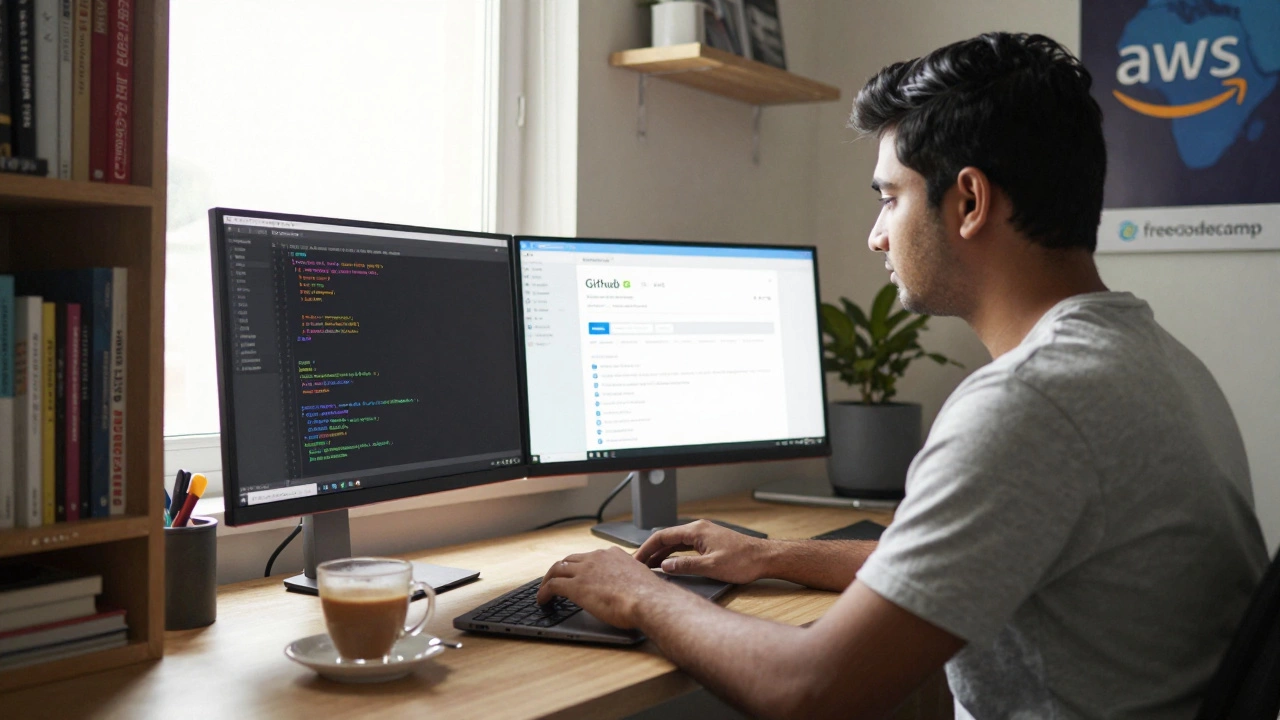
This is the most direct route. You learn HTML, CSS, JavaScript, React, Node.js, and MongoDB. That’s it. No need for Java, Python, or C++. Start with free resources like freeCodeCamp or The Odin Project. Then build 5 real projects: a food delivery app clone, a task manager with user login, a real estate listing site, a blog with comments, and a dashboard that pulls live data.After 6 months, apply for junior developer roles at startups. Your starting salary? ₹6-8 lakh per year. After 18 months of experience, you’re not a junior anymore. You’re a mid-level developer. Companies in Bangalore, Hyderabad, and Pune pay ₹12-18 lakh per year. Add freelance work on Upwork or Toptal-$50/hour for 10 hours a week-and you’re easily hitting $80,000.
One guy from Lucknow, 24, taught himself coding from YouTube. He built a Shopify theme for a Canadian client. That led to another project. Then another. By age 26, he was earning $7,500/month working remotely for U.S. clients. No degree. No interview. Just code.
2. Cloud and DevOps Engineering
This is the hidden gem. Most people don’t realize how much companies pay for people who can set up servers, automate deployments, and keep systems running. You don’t need a degree. You need to master AWS, Docker, Kubernetes, Terraform, and CI/CD pipelines.Start with AWS’s free tier. Build a simple app, deploy it, then automate the deployment with GitHub Actions. Then learn how to monitor it with CloudWatch. Do this for 3 months. Then take the AWS Certified Cloud Practitioner exam. It costs $100. Pass it. Now you’re qualified.
Entry-level cloud roles in India pay ₹8-10 lakh/year. With 1-2 years of experience, you’re managing infrastructure for SaaS companies. That’s ₹18-25 lakh/year. Add consulting gigs on LinkedIn or Fiverr-helping small businesses move to the cloud-and you’re in the $80,000 range.
One woman from Jaipur, 22, dropped out of college. She spent 8 months learning cloud tools. Got certified. Applied to 20 remote jobs. Got hired by a U.S.-based fintech startup. Now she earns $6,500/month. She works from home. Her parents still don’t understand what she does. But they’re proud.
3. AI Prompt Engineering and Automation
This is new. And it’s exploding. You don’t need to code AI. You need to know how to talk to it. Companies are hiring prompt engineers to get the best results from tools like ChatGPT, Claude, and Gemini. They need people who can design workflows that automate customer service, content creation, data entry, and even HR screening.Start by learning how to write prompts that work. Use free courses from DeepLearning.AI or Google’s AI Essentials. Then build 3 automation examples: a chatbot that answers FAQs for a local business, a script that turns meeting notes into reports, a tool that generates product descriptions from a spreadsheet.
Offer these services on Fiverr or Upwork. Charge $20-50 per automation. Land 5 clients a month. That’s $1,000-2,500. Now scale. Build templates. Sell them as digital products. One guy in Indore sells 200 prompt packs a month for $15 each. That’s $3,000/month. He works 10 hours a week. He’s 21. No degree. He’s already making $80,000 a year.
What you actually need to start
You don’t need money. You don’t need a degree. You need three things:- A reliable laptop (even a ₹25,000 one works)
- Internet access (you can use free Wi-Fi at libraries or cafes)
- 2 hours a day, every day, for 6 months
That’s it. No expensive bootcamps. No loan. No waiting. Just consistency.
Here’s a sample 6-month plan:
- Month 1-2: Learn HTML, CSS, JavaScript. Build a personal portfolio site.
- Month 3: Learn React. Build a todo app with local storage.
- Month 4: Learn Node.js and Express. Connect your React app to a backend.
- Month 5: Learn MongoDB. Save user data. Add login.
- Month 6: Deploy your app on Vercel or Netlify. Share it on LinkedIn. Apply for jobs.
By month 7, you’re not a student. You’re a developer.

Where to find jobs (without a degree)
Forget job portals like Naukri.com. They’re filled with degree filters. Go where the real hiring happens:- LinkedIn: Search for “no degree required” + “remote” + “developer” or “cloud”. Message hiring managers directly. Say: “I built X. Can I show you?”
- AngelList: Startups here hire based on skill. Many have no degree requirements.
- Upwork: Start with small gigs. Build reviews. Raise your rate. After 50 reviews, you can charge $40/hour.
- GitHub: Post your code. Write clear READMEs. Companies scout here.
- Reddit: r/forhire, r/india, r/webdev. Post your work. People respond.
One guy from Bhopal got his first job by posting a video of him fixing a bug in a React app. The video got 12,000 views. A startup owner DM’d him. He got hired. No interview. No degree.
Common mistakes to avoid
Most people fail not because they’re not smart. They fail because they do these things:- They watch 50 tutorials but never build anything.
- They switch skills every month-React, then Python, then AI, then blockchain. Focus on one path.
- They wait for “perfect timing.” There’s no perfect time. Start now.
- They think they need to be the best. You just need to be better than the person who gave up yesterday.
Success isn’t about talent. It’s about persistence.
Real stories from India
- Rahul, 23, from Patna: Worked as a call center agent. Spent 1 year learning web dev. Now earns ₹18 lakh/year building apps for U.S. clients. Works from home. Paid off his brother’s education loan. - Meera, 21, from Coimbatore: Left college after 2 years. Learned cloud computing from YouTube. Got certified. Now works for a Berlin-based startup. Makes $6,200/month. She sent her mom a new fridge last month. - Vikas, 25, from Ahmedabad: Didn’t finish high school. Taught himself AI automation. Now sells prompt templates online. Made $90,000 last year. He doesn’t have a phone number. He has a Stripe account.Final thought: Your degree is not your destiny
The world doesn’t care about your college. It cares about what you can do today. If you can build a website, deploy it, fix it, and explain it-you’re worth more than someone with a degree who can’t.Start today. Build one thing. Share it. Get feedback. Improve. Repeat.
Eighty thousand dollars isn’t a fantasy. It’s a math problem. And you’re the solution.
Can I really make $80,000 a year without a degree in India?
Yes. Thousands of people in India are already doing it. They’re working as full-stack developers, cloud engineers, and AI prompt engineers. They didn’t go to college. They learned online, built real projects, and found clients or employers who cared about results-not diplomas. Companies pay for skills, not certificates.
What’s the fastest way to earn $80,000 without a degree?
The fastest path is full-stack web development. With focused effort, you can land your first freelance gig in 4-6 months. By year two, you’re earning ₹15-20 lakh/year locally or $6,000-8,000/month remotely. Add consistent freelance work on Upwork or Toptal, and you’ll hit $80,000 without needing to wait for promotions or corporate ladders.
Do I need to learn coding to make $80,000 without a degree?
Not always. But if you want to reach that income level reliably, coding gives you the most control. You can also make money with AI automation, cloud setup, or digital marketing-but these still require technical skills. You don’t need to be a software engineer, but you do need to understand how technology works. Learning basic coding opens the most doors.
Are online courses worth it for this goal?
Free ones are. Paid courses can help if they’re project-based and include mentorship. But most expensive bootcamps in India don’t deliver better results than free resources like freeCodeCamp, The Odin Project, or YouTube channels like Web Dev Simplified. What matters is what you build-not how much you paid for the course.
What if I’m not good at math or science?
You don’t need advanced math. Web development, cloud setup, and AI automation rely on logic, not calculus. You need to think step-by-step, break problems down, and stay patient. That’s not science. That’s problem-solving. Anyone can learn it. Many top developers in India struggled with math in school. They just kept building things.
How do I get my first client without experience?
Build something for free. Fix a broken website for a local shop. Create a simple app for a friend’s small business. Post it on LinkedIn with a short video showing how it works. Say: “I built this for free. Can I help you next?” Most people say yes. That’s your first client. From there, you charge. Then you scale.
Is remote work the only way to hit $80,000?
No, but it’s the easiest. Indian companies rarely pay that much to junior developers without degrees. But U.S., Canadian, and European companies pay $50-100/hour for skilled remote workers. You can work 20-25 hours a week and still hit $80,000. If you want to stay in India, you’ll need to become a senior developer or start your own agency. Remote work gives you the fastest path.
Leave a comments