Diploma Salary Estimator
Estimate your potential starting salary as a diploma holder in India based on your field of study, location, and experience level.
When people in India talk about a diploma, they’re not just referring to a piece of paper. They’re talking about a real, hands-on path into a job-often faster and cheaper than a four-year degree. But what exactly does diploma level in India mean? And why do so many students, especially after 10th grade, choose it over traditional schooling?
What Is a Diploma in India?
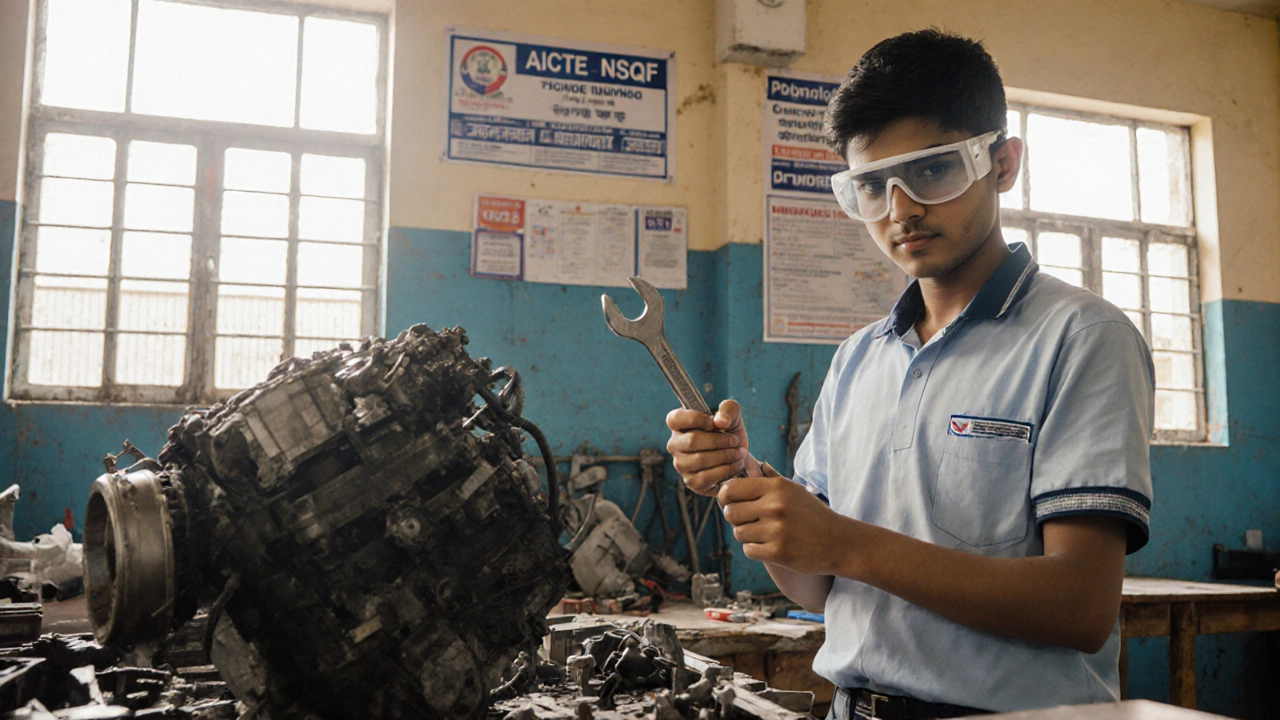
A diploma in India is a post-secondary qualification that comes after completing 10th grade (secondary school). It’s designed to give you practical skills for a specific job, not just theory. You’ll learn by doing-fixing engines, writing code, operating machines, managing patient records, or installing electrical systems.
Unlike degrees, which focus on broad academic knowledge, diplomas are built around industry needs. Most are offered by state technical boards, polytechnics, and private institutes approved by the All India Council for Technical Education (AICTE). These programs usually last between 1 to 3 years, depending on the field.
Think of it like this: a degree teaches you how a car engine works. A diploma teaches you how to fix it-right now, with real tools, on real vehicles.
How Long Does a Diploma Take?
The length of a diploma in India depends on what you’re studying and when you start.
- 1-year diplomas: Usually for students who’ve already completed 12th grade. These are often short-term skill upgrades, like a diploma in computer applications or food safety.
- 3-year diplomas: The most common type. These start after 10th grade and cover core trades like mechanical engineering, civil engineering, electronics, nursing, and hotel management.
- 2-year diplomas: Sometimes offered for students who’ve completed 12th grade in science or commerce, especially in fields like pharmacy or architecture assistance.
For example, a 3-year diploma in mechanical engineering at a government polytechnic in Uttar Pradesh includes six semesters of classroom learning, lab work, and a mandatory 6-month internship in a factory. That’s real experience before you even graduate.
Who Can Enroll?
Most diploma programs in India require you to have passed 10th grade from a recognized board like CBSE, ICSE, or any state board. There’s no strict age limit, so adults returning to education can enroll too.
For engineering and technical diplomas, you’ll need to have studied math and science in 10th grade. For non-engineering diplomas-like in hospitality, fashion, or retail-you can come from any stream. Some institutes even accept students with just basic literacy, especially in rural skill training programs.
Admission is usually based on merit (10th grade marks) or entrance exams like the Polytechnic Entrance Test (PET) in states like Bihar, Haryana, or Maharashtra. Some private colleges use direct admission.
Diploma vs Degree: What’s the Difference?
People often compare diplomas to degrees. Here’s how they stack up:
| Aspect | Diploma | Degree (B.E./B.Tech) |
|---|---|---|
| Duration | 1-3 years | 3-4 years |
| Eligibility | After 10th grade | After 12th grade |
| Focus | Practical skills, job-ready training | Theory + some practice |
| Cost | ₹10,000-₹50,000 total | ₹1-5 lakhs total |
| Starting Salary | ₹12,000-₹25,000/month | ₹25,000-₹45,000/month |
| Path to Higher Education | Can enter B.Tech via lateral entry (2nd year) | Can pursue M.Tech, MBA |
Many students use a diploma as a stepping stone. After finishing a 3-year diploma in computer science, they can join the second year of a B.Tech program through lateral entry. That saves them a full year of study and tuition.
Popular Diploma Courses in India
There are hundreds of diploma options, but here are the most common-and most in-demand-ones:
- Engineering Diplomas: Mechanical, Civil, Electrical, Electronics, Automobile, Chemical. These dominate government polytechnics and are the backbone of India’s skilled workforce.
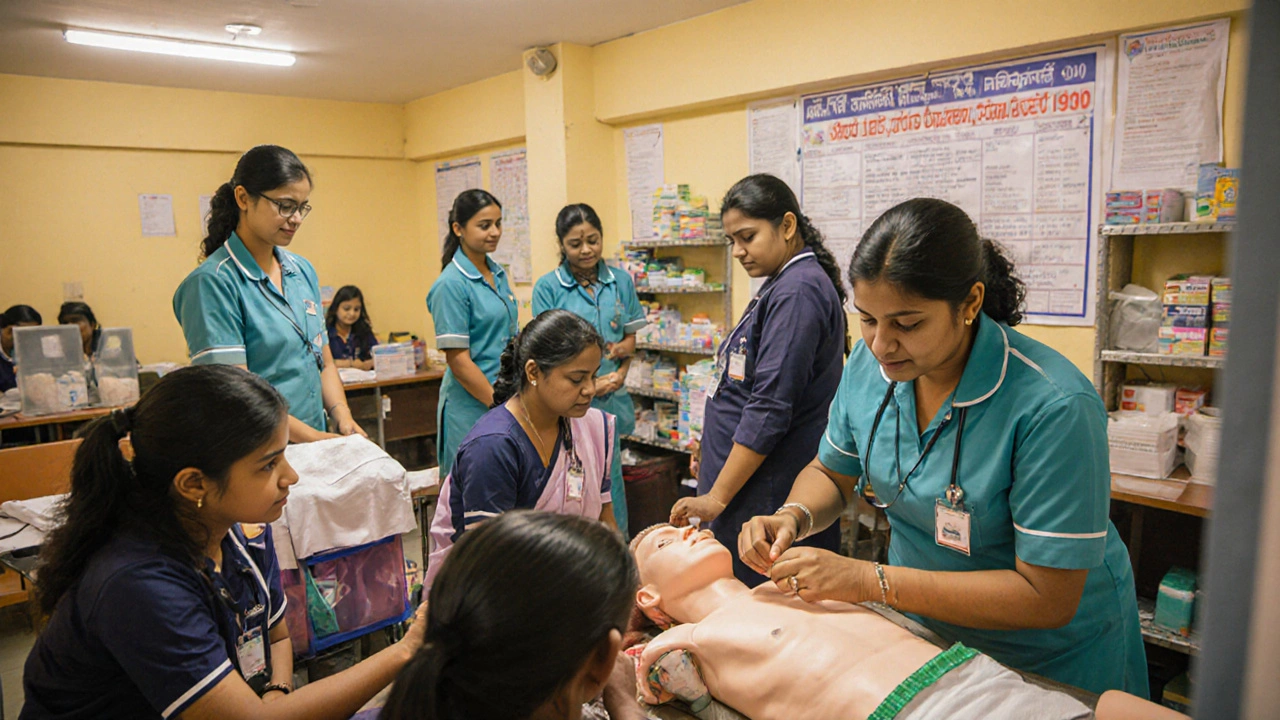
- Healthcare: Diploma in Nursing (ANM, GNM), Medical Lab Technology, Pharmacy Assistant. These are critical in rural clinics and private hospitals.
- IT and Computer: Diploma in Computer Applications (DCA), Hardware & Networking, Cybersecurity. Many graduates land jobs as technicians or junior developers.
- Hotel and Hospitality: Diploma in Hotel Management, Food Production, Front Office. The tourism industry hires these graduates fast.
- Trade and Vocational: Electrician, Plumber, Welder, Tailoring, Beauty & Wellness. These are often run by NSQF-aligned institutes under the Skill India Mission.
For example, a diploma in electrician training from a government industrial training institute (ITI) in Rajasthan includes 1,200 hours of practical work. Graduates are eligible to apply for jobs with BSES, TATA Power, or even start their own electrical repair shop.
Is a Diploma Recognized?
Yes-but not always equally. Government-recognized diplomas from AICTE-approved polytechnics or NSQF-certified ITIs are widely accepted by employers, government jobs, and even for higher education.
Private institutes without AICTE or NCVT approval are risky. Some charge high fees and offer certificates that mean nothing outside their campus. Always check if the institute is listed on the AICTE website or the National Skill Development Corporation (NSDC) portal.
Government jobs like those in railways, defense, state electricity boards, and public sector units (PSUs) actively recruit diploma holders. For example, Indian Railways hires diploma holders in mechanical and electrical trades at entry-level technician roles with starting salaries around ₹25,000/month plus allowances.
Can You Get a Job After a Diploma?
Absolutely. In fact, many industries prefer diploma holders for hands-on roles because they’re trained to work immediately.
Here’s where diploma holders typically find jobs:
- Manufacturing: Factories, automotive plants, steel mills need technicians and operators.
- Construction: Civil diploma holders work as site supervisors or junior engineers.
- Hospitality: Hotels, resorts, and airlines hire diploma graduates for front desk, kitchen, and housekeeping roles.
- IT Support: Computer diploma holders become helpdesk technicians, network assistants, or software testers.
- Healthcare: ANM and GNM nurses work in government health centers, nursing homes, and private clinics.
According to the National Sample Survey Office (NSSO), over 68% of diploma graduates in technical fields find employment within six months of completing their course. That’s higher than many degree holders in non-engineering fields.

What About Higher Education?
Completing a diploma doesn’t mean you’re stuck. You can keep climbing.
After a 3-year diploma in engineering, you can enter the second year of a B.Tech program through the Lateral Entry Scheme. This is called the “lateral entry” or “direct second year” admission. You’ll need to pass an entrance exam like LEET (Lateral Entry Entrance Test) or state-specific tests like ECET (Engineering Common Entrance Test).
Even non-engineering diploma holders can pursue degrees. A diploma in nursing (GNM) can lead to a B.Sc. Nursing. A diploma in hotel management can lead to a Bachelor’s in Hospitality Management.
Some students even go on to get an MBA after their degree. The path isn’t linear-but it’s open.
Government Support and Schemes
The Indian government heavily supports diploma education through skill development programs.
- Skill India Mission: Offers free or subsidized diploma courses in 100+ trades, from solar technician to digital marketing assistant.
- Pradhan Mantri Kaushal Vikas Yojana (PMKVY): Provides certification and cash rewards for completing approved skill courses.
- NSQF Alignment: All recognized diplomas now follow the National Skills Qualification Framework, which means they’re standardized and nationally accepted.
If you’re from a low-income family, you might get full fee waivers, free uniforms, tools, and even a monthly stipend. Many polytechnics in states like Odisha, Jharkhand, and Madhya Pradesh offer these benefits.
Common Mistakes to Avoid
Many students make simple but costly mistakes when choosing a diploma:
- Choosing based on friends: Just because your cousin did a diploma in mechanical engineering doesn’t mean it’s right for you. Ask yourself: Do I like working with my hands? Am I okay with fieldwork?
- Ignoring accreditation: A diploma from an unapproved institute won’t help you get a government job or enter a degree program.
- Thinking it’s "second best": A diploma isn’t a backup plan-it’s a smart, fast track to a stable job. Many people with diplomas earn more than degree holders in the same field.
- Skipping internships: The internship isn’t optional. It’s where you learn the real job. Don’t treat it like a formality.
Final Thoughts
The diploma level in India isn’t a fallback-it’s a powerful, underused option. It’s for students who want to start earning sooner, avoid massive student debt, and learn by doing. It’s for those who don’t want to sit in a lecture hall for four years but still want a respected, stable career.
Whether you want to fix airplanes, run a kitchen, install internet cables, or care for patients, a diploma gives you the skills to do it-and the confidence to prove it.
Is a diploma equal to 12th grade in India?
No, a diploma is not the same as 12th grade. 12th grade is a higher secondary academic qualification, while a diploma is a post-10th grade vocational or technical qualification. A 3-year diploma is considered equivalent to 12th grade plus two years of specialized training. It’s more practical and job-focused than 12th grade.
Can I join engineering after a diploma?
Yes. After completing a 3-year diploma in engineering, you can get direct admission into the second year of a B.Tech program through lateral entry. You’ll need to pass an entrance exam like LEET, ECET, or your state’s equivalent. This saves you one year of study and reduces overall costs.
Are diploma holders eligible for government jobs?
Yes. Many government departments, including Indian Railways, BSNL, Power Grid, State Electricity Boards, and the Armed Forces, hire diploma holders for technician, operator, and supervisor roles. These positions often come with good pay, job security, and benefits.
What’s the average salary after a diploma in India?
Entry-level salaries for diploma holders range from ₹12,000 to ₹25,000 per month, depending on the field and location. Engineering and IT diploma holders in cities like Pune, Bengaluru, or Hyderabad can earn ₹20,000-₹30,000. In rural areas or non-engineering fields, salaries may start at ₹10,000-₹15,000. With experience, this can double within 3-5 years.
Is a diploma better than a degree?
It depends on your goals. If you want to start working quickly, avoid debt, and focus on hands-on skills, a diploma is often better. If you aim for managerial roles, research, or higher education like an MBA or M.Tech, a degree is the standard path. Many people do both-start with a diploma, then pursue a degree later.
Can I do a diploma while working?
Yes. Many institutes offer part-time, evening, or online diploma programs, especially in fields like computer applications, digital marketing, and healthcare. The Skill India Mission also supports flexible learning for working adults. Check with your local polytechnic or NSDC-affiliated center for options.
Leave a comments