Indian Export Sector Career Matcher
Find Your Fit
Select your preferred working style and interests to discover which export sector aligns with your career goals.
This sector is a pillar of the Indian economy.
Select options on the left to see how your skills apply to India's biggest exports.
You might assume that when people talk about Indian exports, they are only talking about textiles or spices. While those industries are iconic, the reality of modern global trade is far more complex and lucrative. If you are studying trade courses in India or looking to understand the economic backbone of the country, knowing exactly what moves across borders is critical. The answer isn't just one item; it depends on whether you count physical goods or services.
In recent years, the landscape has shifted dramatically. For a long time, petroleum products were the undisputed king. Then, information technology took the crown. Today, the picture is split between high-value manufactured goods and massive service exports. Understanding this distinction is the first step toward mastering international commerce.
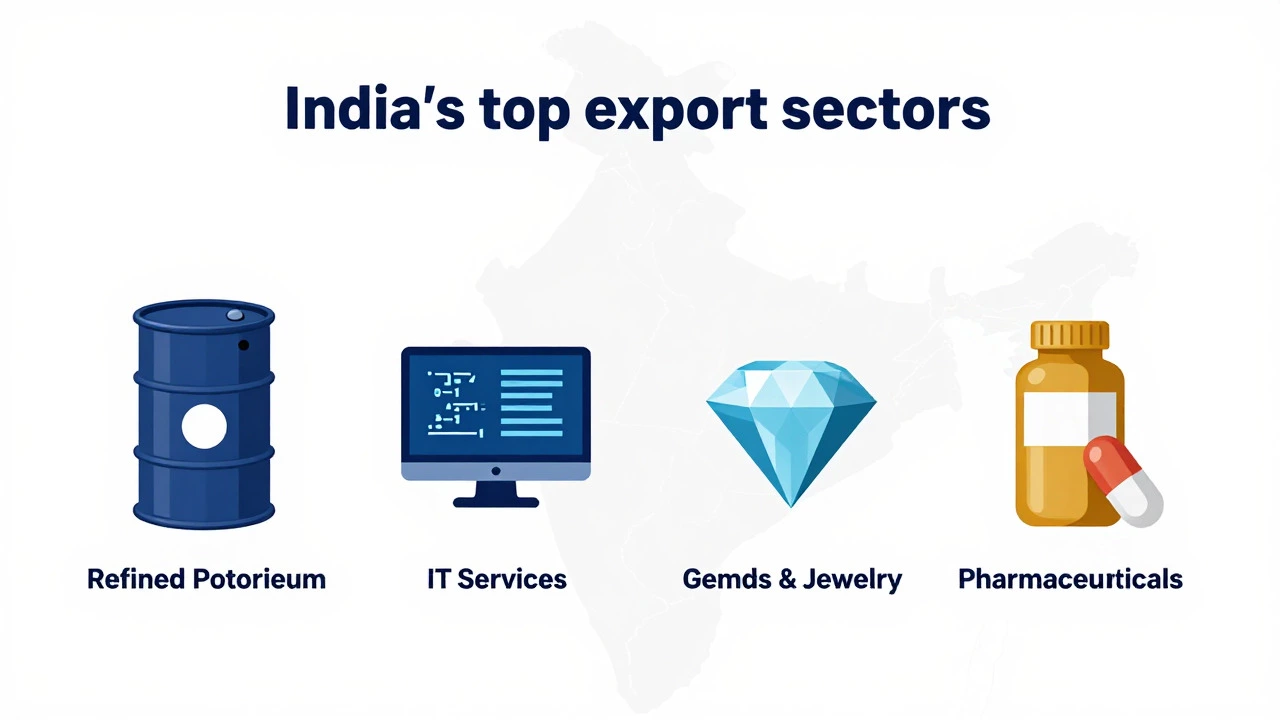
The Physical Champion: Refined Petroleum Products
India has transformed itself from a net importer of refined fuels into a major exporter. How did this happen? It comes down to infrastructure. Over the last decade, companies like Indian Oil Corporation (IOC), Reliance Industries, and Nayara Energy have invested billions in upgrading refineries. These facilities now process heavy crude oils efficiently, turning them into high-demand fuels for markets in Europe, Africa, and Southeast Asia.
Why does this matter to you as a student of trade? Because this sector drives logistics, shipping, and commodity trading. When you study supply chain management, you will see how fluctuations in global crude prices directly impact India’s export revenue. In the fiscal year 2024-2025, refined petroleum products accounted for roughly 15-18% of total merchandise exports. That is a massive chunk of the economy resting on the barrel price of oil.
- Diesel: High demand in African nations where local refining capacity is low.
- Jet Fuel: Critical for aviation hubs in the Middle East and Europe.
- Naphtha: Used globally in petrochemical manufacturing.
If you are interested in the commodities side of trade, this sector offers stable, high-volume opportunities. However, it is also volatile. Geopolitical tensions can spike prices overnight, affecting profit margins for traders.
The Service Giant: Information Technology
Let’s be clear: if you look at the total balance of payments, IT services are often the biggest earner. Companies like TCS, Infosys, Wipro, and HCL Technologies are household names not just in Bangalore or Hyderabad, but in New York and London. They don’t ship boxes; they ship code, support, and expertise.
This shift is crucial for modern trade education. Traditional trade courses focused on shipping containers and customs declarations. Today, digital trade is equally important. You need to understand intellectual property rights, data privacy laws (like GDPR), and cross-border digital contracts. The "product" here is intangible, but the revenue is very real. In 2025, IT-BPM (Business Process Management) exports crossed $250 billion, surpassing many traditional manufacturing sectors.
For students, this means diversifying your skills. Knowing how to negotiate a service-level agreement (SLA) with a US client is just as valuable as knowing how to file a bill of lading for a cargo ship. The future of Indian trade is hybrid: physical goods moving via ships, supported by digital services managed from home.
The Jewel in the Crown: Gems and Jewelry
This industry is fascinating because it combines ancient craftsmanship with modern global finance. Rough diamonds arrive from places like Botswana, Russia, and Canada. Indian artisans cut and polish them, adding significant value before re-exporting them to luxury markets in the US, Europe, and China.
Gold jewelry is another huge sub-segment. Unlike diamonds, gold is often imported as raw material and exported as finished jewelry. This creates a unique trade dynamic involving duty drawbacks and bonded warehouses. If you are taking trade courses in India, pay attention to the chapter on precious metals. The regulations are strict, the margins are thin, and the volume is enormous.
Why is this relevant? Because it teaches you about value addition. Raw materials have one price; finished goods have another. The gap is where the profit lies. India’s dominance in diamond cutting is due to skilled labor and cluster-based production. This model is being replicated in other sectors, such as textile embroidery and leather goods.
The Health Pillar: Pharmaceuticals
This sector is driven by necessity and cost-efficiency. Western countries rely on Indian generics because they are affordable and meet rigorous quality standards set by the FDA (US Food and Drug Administration) and EMA (European Medicines Agency). During the pandemic, this dependency became glaringly obvious.
From a trade perspective, pharma exports require deep knowledge of regulatory compliance. You aren’t just moving boxes; you are moving life-saving drugs that must maintain specific temperature controls (cold chain logistics). A failure in documentation or temperature monitoring can mean millions in losses and legal penalties.
Key areas within this sector include:
- Generics: High volume, lower margin, steady demand.
- Vaccines: High tech, government-to-government deals.
- Active Pharmaceutical Ingredients (APIs): The raw chemicals used to make drugs. India is still catching up here, importing many APIs from China, which is a strategic vulnerability.
For aspiring traders, this sector offers stability. People always need medicine. But it requires patience and meticulous attention to detail. Regulatory hurdles are high, but once you clear them, the barriers to entry for competitors are also high.
Other Notable Exports
While the four categories above dominate the headlines, other sectors play vital roles. Textiles and apparel remain a major employer, especially in states like Gujarat, Maharashtra, and Tamil Nadu. However, they face stiff competition from Bangladesh and Vietnam due to lower labor costs there.
Engineering goods, including auto components and machinery parts, are growing rapidly. As global manufacturers seek alternatives to Chinese supply chains (the "China Plus One" strategy), Indian engineering firms are benefiting. This is a great area for students interested in industrial trade and B2B relationships.
Agricultural products like rice, basmati, and spices are culturally significant but smaller in monetary value compared to petroleum or IT. Rice exports, in particular, have seen volatility due to government export bans aimed at controlling domestic inflation. This highlights a key lesson in trade: policy decisions can instantly change market dynamics.
| Sector | Type | Key Markets | Primary Challenge |
|---|---|---|---|
| Refined Petroleum | Goods | Europe, Africa, SE Asia | Crude price volatility |
| IT Services | Services | USA, UK, Europe | Talent retention, visa policies |
| Gems & Jewelry | Goods | USA, UAE, Europe | Rough stone availability, energy costs |
| Pharmaceuticals | Goods | Global (especially USA) | Regulatory compliance, API imports |
| Textiles | Goods | USA, EU | Competition from Bangladesh/Vietnam |
Why This Matters for Your Career
If you are pursuing trade courses in India, understanding these sectors helps you choose a specialization. Do you want to work in the fast-paced, high-stakes world of commodity trading? Or do you prefer the structured, relationship-driven environment of B2B engineering exports? Maybe you are drawn to the regulatory complexity of pharma?
The job market reflects these trends. Logistics companies need experts who understand cold chain requirements for pharma. Shipping lines need analysts who track crude oil flows. Tech firms need professionals who understand cross-border data laws. Your education should bridge the gap between theory and these practical realities.
Look for programs that offer internships with real exporters. Theory is useful, but seeing how a shipment of diamonds is insured, or how an IT contract is negotiated, provides invaluable experience. The best trade professionals are those who understand both the numbers and the nuances of each industry.
Future Trends to Watch
The next five years will bring significant changes. Green energy is emerging as a new export frontier. India is investing heavily in solar module manufacturing and green hydrogen. By 2030, these could become major export categories, reducing reliance on fossil fuels.
Digital trade will continue to grow. E-commerce platforms are making it easier for small businesses to export niche products like handicrafts, organic foods, and fashion accessories. This democratization of trade means you don’t need a large factory to participate in global commerce.
Finally, regional trade agreements will reshape routes. Deals with the European Union, UK, and Australia will reduce tariffs on Indian goods. Understanding these agreements is part of modern trade literacy. Know which products benefit from lower duties, and you can advise clients better.
Is IT considered an export in India?
Yes, IT services are counted as invisible exports. They contribute significantly to India's GDP and foreign exchange reserves, often surpassing merchandise exports in total value.
What is the single biggest merchandise export from India?
Refined petroleum products are typically the largest merchandise export by value, followed closely by gems and jewelry and pharmaceuticals depending on global oil prices.
Which trade course is best for exporting pharmaceuticals?
Courses focusing on regulatory affairs, supply chain management, and international business law are most beneficial. Look for programs that cover FDA compliance and cold chain logistics.
How does India's export profile compare to China's?
China dominates in electronics and heavy manufacturing. India leads in services (IT), pharmaceuticals, and specialized sectors like diamond processing. Both countries are competing in engineering goods and textiles.
Are trade courses in India worth it for beginners?
Absolutely. They provide foundational knowledge in documentation, logistics, and international law. Practical exposure through internships enhances employability in export houses and logistics firms.
Leave a comments