
Career Future-Proofing Checker
Are you at risk? Select your primary job function below to see your automation exposure and recommended next steps according to the latest labor trends.
Select a role and click "Analyze" to see your results.
You’re scrolling through LinkedIn, and suddenly a post catches your eye: "AI just replaced my entire team." It’s not fear-mongering; it’s happening right now. If you’re wondering what jobs will be gone in the next 5 years, you aren’t alone. The landscape of work is shifting faster than most people realize, driven by artificial intelligence, automation, and changing consumer habits. But here’s the good news: while some roles are disappearing, others are exploding. This isn’t about doom and gloom; it’s about getting ahead of the curve so you don’t get left behind.
The reality is that technology doesn’t just steal jobs-it transforms them. Tasks that were once done by hand or basic software are now handled by algorithms. According to recent reports from the World Economic Forum, roughly 85 million jobs may be displaced by a shift in the division of labour between humans and machines by 2025, but 97 million new roles may emerge. So, which side of that equation are you on? Let’s break down the specific roles at risk and, more importantly, what you can do about it.
Why Your Job Might Be on the Chopping Block
Before we list specific titles, you need to understand the pattern. Automation loves two things: repetition and predictability. If your daily tasks involve following a strict set of rules with little variation, an algorithm can probably do it cheaper, faster, and without needing coffee breaks. Think about data entry clerks. Ten years ago, this was a solid career path. Today, Optical Character Recognition (OCR) tools and Robotic Process Automation (RPA) software can scan invoices, extract data, and enter it into systems with near-perfect accuracy. Humans are still needed for exceptions, but the volume of pure entry-level data work has plummeted.
Artificial Intelligence (AI) is the simulation of human intelligence processes by computer systems, including learning, reasoning, and self-correction. Unlike traditional software, AI learns from data, making it increasingly capable of handling complex, non-routine tasks that previously required human judgment. This evolution means that even white-collar jobs aren't safe. Paralegals who spent hours reviewing contracts are now seeing AI tools draft initial reviews in seconds. The value shifts from doing the work to managing the output of the machine.
Specific Roles Facing Rapid Decline
Let’s get concrete. Which specific titles are showing signs of extinction? While no job vanishes overnight, the trajectory for these roles is steeply downward.
- Data Entry Clerks: As mentioned, OCR and RPA are eating this market alive. If your primary skill is typing speed, you’re vulnerable.
- Telemarketers: Consumers hate cold calls, and AI voice bots are getting eerily good at mimicking human conversation. Plus, regulations around spam calls are tightening globally.
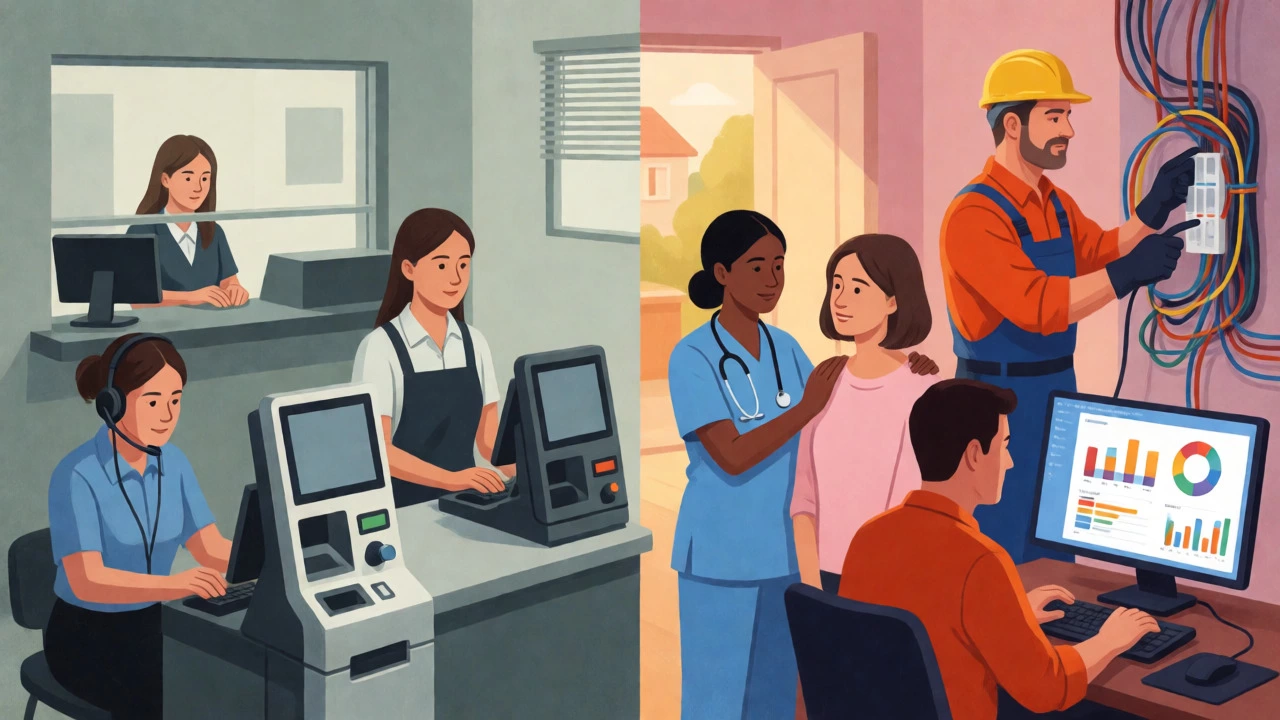
- Bank Tellers: Mobile banking apps handle deposits, transfers, and check cashing. Branches are shrinking, and teller windows are becoming rare.
- Bookkeepers: Cloud accounting platforms like QuickBooks and Xero automate categorization and reconciliation. The role is evolving into a strategic advisory position, leaving pure bookkeeping behind.
- Retail Cashiers: Self-checkout kiosks and Amazon Go-style cashier-less stores are expanding beyond tech hubs into mainstream retail.
It’s not just low-skill labor. Even specialized fields are feeling the heat. For instance, Manufacturing Technicians are skilled workers who install, maintain, and repair industrial machinery. However, as factories adopt Industry 4.0 standards, routine maintenance is being predicted by IoT sensors, reducing the need for manual inspection crews.
The Rise of Human-Centric Skills
If robots are taking over logic and repetition, what’s left for us? Empathy, creativity, and complex problem-solving. These are areas where AI struggles. You can’t program a robot to genuinely comfort a grieving patient or negotiate a nuanced business deal involving emotional stakes. This is why healthcare, education, and creative industries are growing despite technological advances.
Consider nurses. The aging population in Canada and elsewhere means demand for healthcare services is skyrocketing. Robots might deliver meds or monitor vitals, but they can’t replace the human connection a nurse provides. Similarly, skilled trades like electricians and plumbers are incredibly resistant to automation. Why? Because every house is different. Wiring a century-old home in Toronto requires adaptability and physical dexterity that current robotics simply cannot match at a reasonable cost.
| Sector | Automation Risk Level | Primary Driver | Human Advantage |
|---|---|---|---|
| Retail & Customer Service | High | Chatbots, Self-checkout | Complex conflict resolution |
| Finance & Accounting | Medium-High | Algorithmic trading, Auto-bookkeeping | Strategic financial planning |
| Skilled Trades | Low | Limited robotics flexibility | Physical dexterity, Problem-solving |
| Healthcare | Low-Medium | Diagnostic AI | Empathy, Patient care |
| Creative Arts | Medium | Generative AI tools | Originality, Cultural context |
How to Future-Proof Your Career Now
So, what do you do if your job looks shaky? Don’t panic. Pivot. The key is upskilling or reskilling. You don’t necessarily need a four-year degree again. In fact, targeted Vocational Training is education focused on practical skills for specific trades or occupations. It often leads to faster employment and higher starting wages than general liberal arts degrees in many technical fields. can be more valuable.
Here is a simple framework to assess your next move:
- Audit Your Tasks: Write down everything you do in a week. Highlight tasks that are repetitive and rule-based. Those are your danger zones.
- Identify High-Value Skills: Look for skills that require judgment, interpersonal interaction, or creative thinking. Double down on those.
- Learn to Work With AI: Instead of competing with AI, learn to use it. A marketer who knows how to prompt-generate copy is more valuable than one who writes every word manually.
- Get Certified: Employers trust credentials. Whether it’s a coding bootcamp certificate or a trade license, proof of competence matters.
In Toronto, for example, there’s a massive demand for digital marketers who understand data analytics. It’s not just about posting on Instagram anymore; it’s about interpreting user behavior data to drive sales. A short course in digital marketing can bridge the gap between a stagnant admin role and a dynamic growth specialist role.
The Role of Free Skill Training Platforms
You might think retraining costs thousands of dollars. Not always. There are numerous free or low-cost resources available today. Platforms like Coursera, edX, and Khan Academy offer courses from top universities. Many governments also subsidize training programs for residents looking to switch careers. In Canada, initiatives often target sectors like green energy, tech, and healthcare.
Take Digital Marketing as the promotion of products or brands via one or more forms of electronic media. It is a field that evolves rapidly, requiring continuous learning rather than static knowledge. is a great example. You can start with free tutorials on SEO basics, then move to paid certifications if you want to specialize further. The barrier to entry is low, but the ceiling is high. The same applies to coding. Python is a beginner-friendly language that opens doors to data science and web development.

Don’t Ignore the Gig Economy Shifts
Gig work is changing too. Ride-sharing drivers and delivery couriers face pressure from autonomous vehicle developments. While fully driverless fleets aren’t everywhere yet, pilot programs are running in major cities. If you rely on driving for income, consider diversifying. Maybe you combine delivery with freelance writing or virtual assistant work. Flexibility is your safety net.
Also, watch out for "ghost jobs"-positions posted online that never get filled because companies are testing the market or hoarding talent. When applying for new roles, look for companies investing in employee development. Ask interview questions like, "How does your company support upskilling?" Their answer tells you a lot about their future-proofing strategy.
Action Plan: Your Next 12 Months
Waiting until your job disappears is risky. Start now. Here’s a realistic timeline:
- Months 1-3: Research. Pick one skill that aligns with your interests and market demand. Test it with free resources.
- Months 4-6: Commit. Enroll in a structured course or certification. Dedicate 5-10 hours a week.
- Months 7-9: Apply. Build a portfolio or take on small freelance projects to prove your new skill.
- Months 10-12: Transition. Update your resume, network actively, and apply for roles that blend your old experience with your new skill.
Remember, the goal isn’t to become a robot. It’s to become a human who understands robots. That combination is unbeatable.
Will AI really replace all customer service jobs?
No, not all of them. AI chatbots are excellent for handling simple, repetitive queries like tracking orders or resetting passwords. However, complex issues requiring empathy, negotiation, or deep product knowledge still require humans. The number of entry-level agents may drop, but the role of senior customer success managers will likely grow.
Are skilled trades safe from automation?
Yes, relatively speaking. Jobs like plumbing, electrical work, and construction require navigating unpredictable physical environments. Current robotics technology is expensive and lacks the dexterity and adaptability needed for these tasks. Demand for skilled tradespeople is actually increasing due to infrastructure updates and housing shortages.
Is it too late to change careers at 40 or 50?
Absolutely not. Many professionals successfully pivot mid-career. Your previous experience gives you soft skills like communication, project management, and reliability, which are highly valued. Pairing those with a new technical skill makes you a powerful candidate. Age brings perspective that younger entrants lack.
Do I need a university degree to survive the future of work?
Not necessarily. While degrees still matter in fields like medicine and law, many high-growth sectors prioritize skills and portfolios over formal education. Coding, digital marketing, and skilled trades often value certifications and demonstrable ability more than a bachelor's degree. Focus on acquiring relevant, verifiable skills.
What is the biggest mistake people make when fearing job loss?
Passivity. People wait for the layoff notice before updating their resumes or learning new skills. The best time to prepare is when you’re employed. Continuous learning prevents the shock of sudden displacement and keeps your employability high regardless of industry trends.
Leave a comments