
Electrician's Circuit Calculator
Circuit Analysis Tool
Select two known values to calculate the missing variables in a DC or single-phase AC circuit.
Results
Formulas Used
You don’t need a PhD in calculus to hang lights or run circuits. In fact, if you’re sitting in an electrician training program wondering if your high school algebra skills are enough, take a deep breath. The short answer is: basic arithmetic, some geometry, and a handful of specific formulas. That’s it.
But there’s a catch. You can’t just memorize these formulas like flashcards. You have to understand how they connect to the physical world-why a wire gets hot, why a breaker trips, and how to calculate the exact length of conduit for a job site. This article breaks down exactly what math you’ll use daily on the job, moving from simple measurements to the core electrical laws that keep buildings safe.
The Foundation: Arithmetic and Fractions
Before you touch a multimeter, you need to be comfortable with numbers. Most apprentice electricians are skilled tradespeople who install, maintain, and repair electrical wiring systems spend their first few years mastering measurement. This isn’t abstract theory; it’s about reading a tape measure accurately.
- Fractions: Imperial measurements rely heavily on fractions. You need to add 3/8 inch to 5/16 inch quickly without reaching for a calculator every time. Understanding common denominators is crucial when fitting boxes into tight spaces.
- Decimals: Metric systems and many digital tools use decimals. Converting between fractions (like 1/4") and decimals (0.25") must become second nature.
- Percentages: You’ll use percentages constantly for discounts on materials, calculating load capacities, and understanding efficiency ratings of transformers or motors.
If you struggle here, pause your study of complex circuits. Mastering addition, subtraction, multiplication, and division with fractions and decimals is non-negotiable. It’s the language of the job site.
Geometry: Measuring the World Around You
Electrical work is three-dimensional. You aren’t just running wires in straight lines; you’re navigating around beams, through walls, and across ceilings. Geometry helps you plan these paths efficiently, saving material and time.
| Concept | Application | Why It Matters |
|---|---|---|
| Area | Calculating square footage of rooms | Determining lighting loads and cable tray fill capacity |
| Volume | Measuring junction boxes | Ensuring code compliance for box fill calculations |
| Pythagorean Theorem | Finding diagonal distances | Cutting conduit at angles or measuring roof slopes |
| Circumference | Bending conduit | Calculating the length of bends in EMT tubing |
For example, when bending EMT conduit is a type of thin-walled steel pipe used to protect electrical wires, you need to know the circumference of the bend to determine how much extra material you’ll need. If you’re installing a light fixture in the center of a room, you might use the Pythagorean theorem ($a^2 + b^2 = c^2$) to find the exact distance from a corner to the center point, ensuring perfect symmetry.
Ohm’s Law: The Heart of Electrical Math
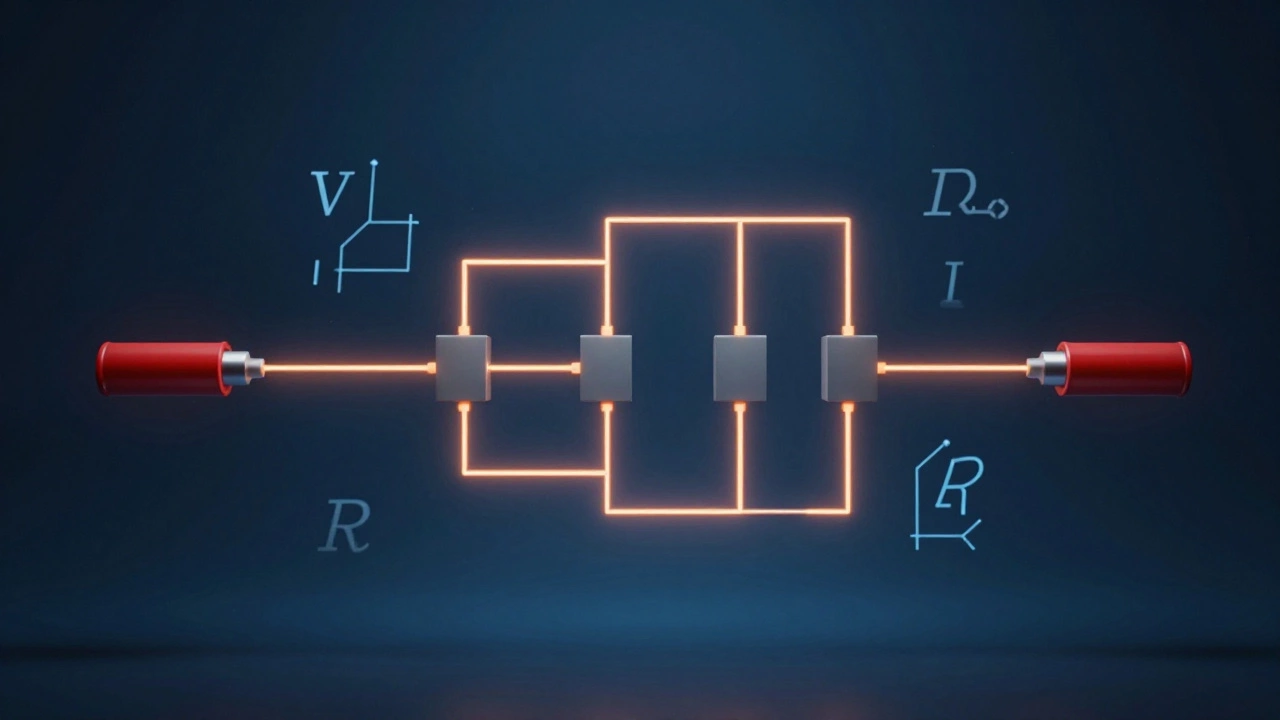
If you only remember one thing from this article, let it be Ohm’s Law. Discovered by Georg Simon Ohm in 1827, this principle is the foundation of all electrical circuit analysis. It describes the relationship between voltage, current, and resistance.
The formula is simple: $V = I \times R$.
- V (Voltage): The pressure pushing electrons through the circuit (measured in Volts).
- I (Current): The flow of electrons (measured in Amperes or Amps).
- R (Resistance): The opposition to the flow (measured in Ohms).
Why does this matter? Imagine a customer complains that their heater isn’t getting hot. You measure the voltage at the outlet and get 120V. You know the heater is rated for 1500 Watts. Using the power variation of Ohm’s Law ($P = V \times I$), you can calculate the expected current draw: $I = P / V = 1500 / 120 = 12.5$ Amps. If your multimeter shows only 5 Amps flowing, you know there’s a problem-likely a loose connection adding resistance or a faulty heating element.
This diagnostic ability separates a handyman from a licensed electrician. You aren’t guessing; you’re calculating.
Power Calculations: Watts, Volts, and Amps
Once you grasp Ohm’s Law, you move to power calculations. Power is the rate at which electrical energy is transferred by an electric circuit. It’s measured in Watts (W). For residential single-phase circuits, the formula is straightforward:
$\text{Watts} = \text{Volts} \times \text{Amps}$
However, commercial and industrial settings often use three-phase power. Here, the math changes slightly due to the phase angle. The formula becomes:
$\text{Watts} = \sqrt{3} \times \text{Volts} \times \text{Amps} \times \text{Power Factor}$
$\sqrt{3}$ is approximately 1.732. You don’t need to derive this, but you do need to know when to apply it. Misapplying single-phase formulas to three-phase motors will lead to incorrect wire sizing and potential fire hazards.
Let’s look at a real-world scenario. You’re installing a 20-horsepower motor. One horsepower equals 746 Watts. So, the motor draws $20 \times 746 = 14,920$ Watts. If it’s a 480-volt three-phase motor with a power factor of 0.85, you calculate the amperage to select the correct breaker and wire size. This calculation ensures safety and code compliance.
Wire Sizing and Voltage Drop
Choosing the right wire gauge isn’t just about carrying current; it’s about preventing voltage drop over long distances. As electricity travels through a wire, resistance causes a loss of voltage. If the voltage drops too much, devices won’t operate correctly, and the wire may overheat.
The National Electrical Code (NEC) recommends keeping voltage drop under 3% for branch circuits. To calculate this, you need to know the length of the run, the current load, and the resistivity of the copper or aluminum wire.
While the full formula involves circular mils and resistivity constants, most electricians use simplified tables or apps derived from these principles. However, understanding the concept helps you troubleshoot. If a pump at the end of a 100-foot run hums but doesn’t start, voltage drop is a prime suspect. Upgrading from 12-gauge to 10-gauge wire reduces resistance and restores performance.

Trigonometry: Advanced Bends and Layouts
As you advance in your career, you’ll encounter more complex conduit bends. While simple offsets can be calculated with multipliers, offsetting conduit around obstacles often requires basic trigonometry.
Sine, cosine, and tangent help you determine the exact degree of bend needed. For instance, if you need to raise a conduit 10 inches vertically over a horizontal distance of 30 inches, you use the tangent function:
$\tan(\theta) = \frac{\text{Opposite}}{\text{Adjacent}} = \frac{10}{30} = 0.333$
Using a calculator, you find that $\theta$ is approximately 18.4 degrees. Knowing this allows you to set your bender precisely, avoiding costly mistakes and rework.
Practical Tips for Mastering Electrician Math
Math anxiety is common among new apprentices. Here’s how to overcome it:
- Practice Daily: Spend 10 minutes a day solving simple problems related to Ohm’s Law and geometry.
- Use Tools Wisely: Keep a scientific calculator app on your phone. Learn its functions so you can compute quickly on site.
- Visualize Problems: Draw diagrams. Sketching a circuit or a conduit run helps translate abstract numbers into physical reality.
- Learn the Codes: The NEC provides tables that simplify complex calculations. Memorize key tables for wire ampacity and box fill.
- Ask Questions: Don’t be afraid to ask journeymen how they arrived at a number. They often have shortcuts based on years of experience.
Remember, the goal isn’t to become a mathematician. It’s to become a safe, efficient, and reliable electrician. The math is just the tool that gets you there.
Do electricians need to know calculus?
No, typical residential and commercial electricians do not need calculus. Basic algebra, geometry, and arithmetic are sufficient for 99% of field tasks. Calculus is used in electrical engineering for designing circuits and analyzing complex waveforms, but not for installation and maintenance.
Is the math hard for beginners?
It can seem challenging at first, especially if you haven’t used math in years. However, electrician math is practical and repetitive. Once you understand the core concepts like Ohm’s Law and wire sizing, the calculations become routine. Practice makes it easier.
What is the most important formula for an electrician?
Ohm’s Law ($V = I \times R$) and the Power Formula ($P = V \times I$) are the most critical. These two formulas allow you to diagnose almost any electrical issue, from tripped breakers to faulty appliances, by calculating expected versus actual values.
How do I calculate voltage drop?
Voltage drop depends on wire length, current, and wire gauge. A simplified formula for single-phase is: $VD = \frac{2 \times K \times L \times I}{CM}$, where K is the resistivity constant, L is length, I is current, and CM is circular mil area. Most electricians use online calculators or NEC tables for quick estimates.
Do I need to memorize all the formulas?
You should understand the relationships between variables rather than rote-memorizing every formula. Knowing that increasing resistance decreases current (Ohm’s Law) is more valuable than memorizing the equation. Reference guides and apps are standard tools on the job site.
Leave a comments