US Degree Validity Checker for Indian Students
Enter your educational details below to see how US universities and employers typically view your credentials.
Equivalency Status:
PendingRecommended Actions:
You spent four years grinding through engineering college or a three-year bachelor's program in India. You got your mark sheet, maybe even topped your batch. Now you're eyeing a Master's in Computer Science at Stanford or a job offer from a tech firm in Seattle. But then the doubt creeps in: Is my Indian degree actually valid in the USA?
The short answer is yes-but with a massive asterisk. The United States doesn't have a single government agency that "approves" foreign degrees. Instead, validity depends on context. Are you applying for university admission? You need an evaluation service. Are you looking for a visa sponsorship like H-1B? Your employer and USCIS (U.S. Citizenship and Immigration Services) will look for specific equivalencies. If you are trying to practice medicine or law, it’s a whole different beast.
How the US System Views Foreign Credentials
American universities and employers don't just take your transcript at face value because grading scales vary wildly. An 80% in India might mean something completely different than an 80% in Canada or the UK. This is where credential evaluation comes in. It is the process of converting foreign educational records into their U.S. equivalents. Think of it as a translator for your academic history.
Most top-tier US universities require this translation before they’ll even read your application. They want to know if your Bachelor of Technology (B.Tech) from a Tier-2 Indian institute equates to a US Bachelor of Science. Usually, a four-year Indian degree is considered equivalent to a US bachelor's degree. A three-year Indian degree often falls short, sometimes requiring you to complete a one-year postgraduate diploma or a master's degree in India first to meet the requirement.
The Big Three Evaluation Agencies
You can’t just ask your local college registrar to write a letter saying your degree is good enough. You need third-party validation. In the US market, three names dominate this space. Knowing which one to use saves you money and time.
| Agency | Best For | Turnaround Time | Cost Estimate (USD) |
|---|---|---|---|
| WES | University Admissions & General Use | 7-35 business days | $200 - $300 |
| ECE | Nursing, Teaching, & Specific States | 5-20 business days | $150 - $250 |
| SpanTran | General Equivalency | 5-10 business days | $100 - $150 |
World Education Services (WES) is the heavyweight champion here. Most US universities explicitly state they accept WES evaluations. If you’re applying to grad school, start here. Their "Course-by-Course" report is detailed, listing every subject you took and its US credit equivalent. This helps admissions officers see that your advanced calculus matches their curriculum.
Educational Credential Evaluators (ECE) is often preferred by nursing boards and teaching councils. If you plan to work as a nurse in California or Texas, check if they prefer ECE over WES. Some states have specific rules about who evaluates your credentials, so don't assume WES works everywhere.
SpanTran is cheaper and faster but less universally recognized by elite universities. It’s fine for general employment verification or smaller colleges, but always check the specific requirements of your target institution first.
Degree Duration Matters More Than You Think
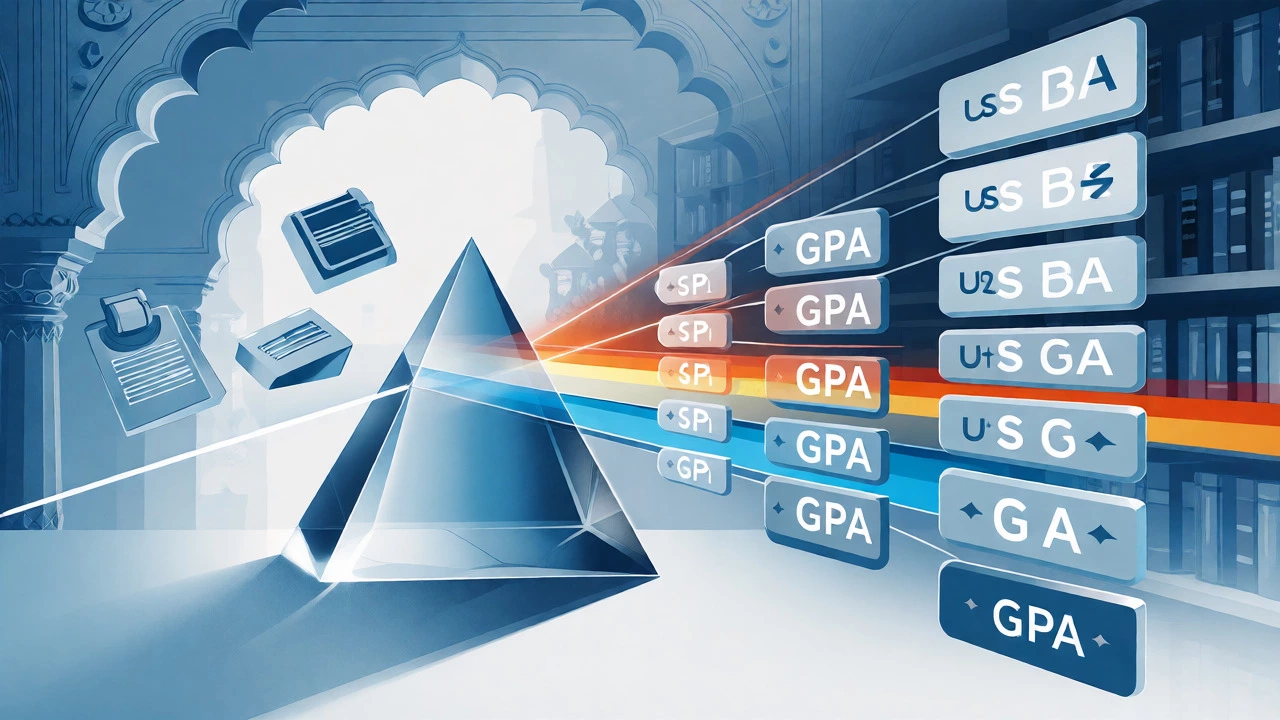
This is the biggest hurdle for Indian students. The US education system is built on a four-year undergraduate model. If you completed a three-year Bachelor of Arts (BA) or Bachelor of Commerce (B.Com) in India, many US universities will not consider it a full bachelor's degree equivalent.
Here’s the rule of thumb: If you have a three-year degree, you usually need to add one year of relevant postgraduate study in India to qualify for direct entry into a US Master’s program. Alternatively, some US universities offer "conditional admission." This means you get accepted, but you must take extra undergraduate-level courses during your first semester. This costs more time and tuition, so weigh the options carefully.
Four-year degrees like B.E., B.Tech, B.Sc. (Hons), and integrated five-year programs (like B.Arch or LL.B.) generally sail through. They map directly to the US four-year standard. No extra hoops needed.
Professional Licenses: Medicine, Law, and Engineering
An academic degree gets you into school or a generic corporate job. But if you want to be a doctor, lawyer, or licensed engineer, your degree alone isn't enough. These professions are regulated at the state level.
Medicine: If you hold an MBBS from India, you cannot simply walk into a US hospital and start practicing. You must pass the USMLE (United States Medical Licensing Examination). This is a grueling three-step exam series. After passing, you still need to match into a residency program, which is highly competitive for international medical graduates (IMGs).
Law: An LL.B. from India does not allow you to practice law in New York or California immediately. You typically need to earn a LL.M. (Master of Laws) from an accredited US law school. Even then, bar eligibility varies by state. New York allows foreign lawyers with an LL.M. to sit for the bar; other states do not.
Engineering: To sign off on public projects, you need a Professional Engineer (PE) license. The path involves getting your degree evaluated, passing the FE (Fundamentals of Engineering) exam, gaining four years of supervised work experience, and then passing the PE exam. Your Indian B.Tech is valid for starting this process, but the exams are US-specific.

Visa Implications: H-1B and OPT
If you’re moving to the US for work, your degree validity ties directly to your visa status. For the H-1B visa, USCIS requires that the position be a "specialty occupation" and that you possess at least a bachelor’s degree (or higher) in a field related to the job.
If your degree is from India, you must prove it meets the US standard. Often, USCIS accepts a combination of education and experience. A common formula used is: three years of specialized work experience equals one year of college. So, if you have a three-year degree plus three years of relevant IT experience, you might argue you meet the four-year requirement. However, relying on this "experience-for-degree" substitution is risky. It’s safer to have a four-year degree or a completed master's degree in India before applying.
For students coming to the US on an F-1 visa, completing a degree grants you Optional Practical Training (OPT). STEM-designated degrees (like CS, Engineering, Math) get a 24-month extension, totaling three years of work authorization. Non-STEM degrees only get 12 months. Check if your Indian major maps to a STEM category in the US system-it affects how long you can stay without a visa sponsor.
Common Pitfalls to Avoid
Don't wait until the last minute. Evaluation services can get backed up, especially during peak admission seasons (January to March). Start the process six months before your deadline.
Make sure your documents are sent correctly. Most agencies require original transcripts sent directly from your Indian university in sealed envelopes. If you send them yourself, they might reject them. Also, ensure your name spelling matches exactly across all documents-passport, mark sheets, and degree certificate. Discrepancies cause delays.
Beware of "diploma mills." If your college isn't recognized by the University Grants Commission (UGC) or the All India Council for Technical Education (AICTE), US evaluators likely won't recognize it either. Stick to accredited institutions.
Is a 3-year Indian degree valid for US Masters?
Generally, no. Most US universities require a 4-year undergraduate degree. With a 3-year degree, you usually need to complete a 1-year PG Diploma or a Master's degree in India first, or apply for conditional admission which may require extra coursework.
Do I need WES for every US university?
Not necessarily, but most do. Some universities have their own international admissions offices that evaluate credentials internally. Always check the specific application instructions for each university. If they don't specify, WES is the safest bet.
Can I work in the USA with an Indian MBA?
Yes, but you need a work visa. An MBA helps secure jobs in management consulting, marketing, or finance. However, you must find an employer willing to sponsor an H-1B visa. The degree itself doesn't grant work rights; the visa does.
Is a distance learning degree from India valid in the USA?
It depends. Degrees from open universities (like IGNOU) are often accepted if the university is recognized by the UGC and the Association of Indian Universities (AIU). However, some strict US universities may view purely online/distance degrees less favorably than regular full-time degrees. Evaluation services will assess the accreditation status specifically.
How much does a WES evaluation cost?
As of 2026, a basic course-by-course evaluation from WES typically costs between $200 and $300 USD. Rush fees can add another $100-$150 depending on how fast you need the report.
Leave a comments